
Overview
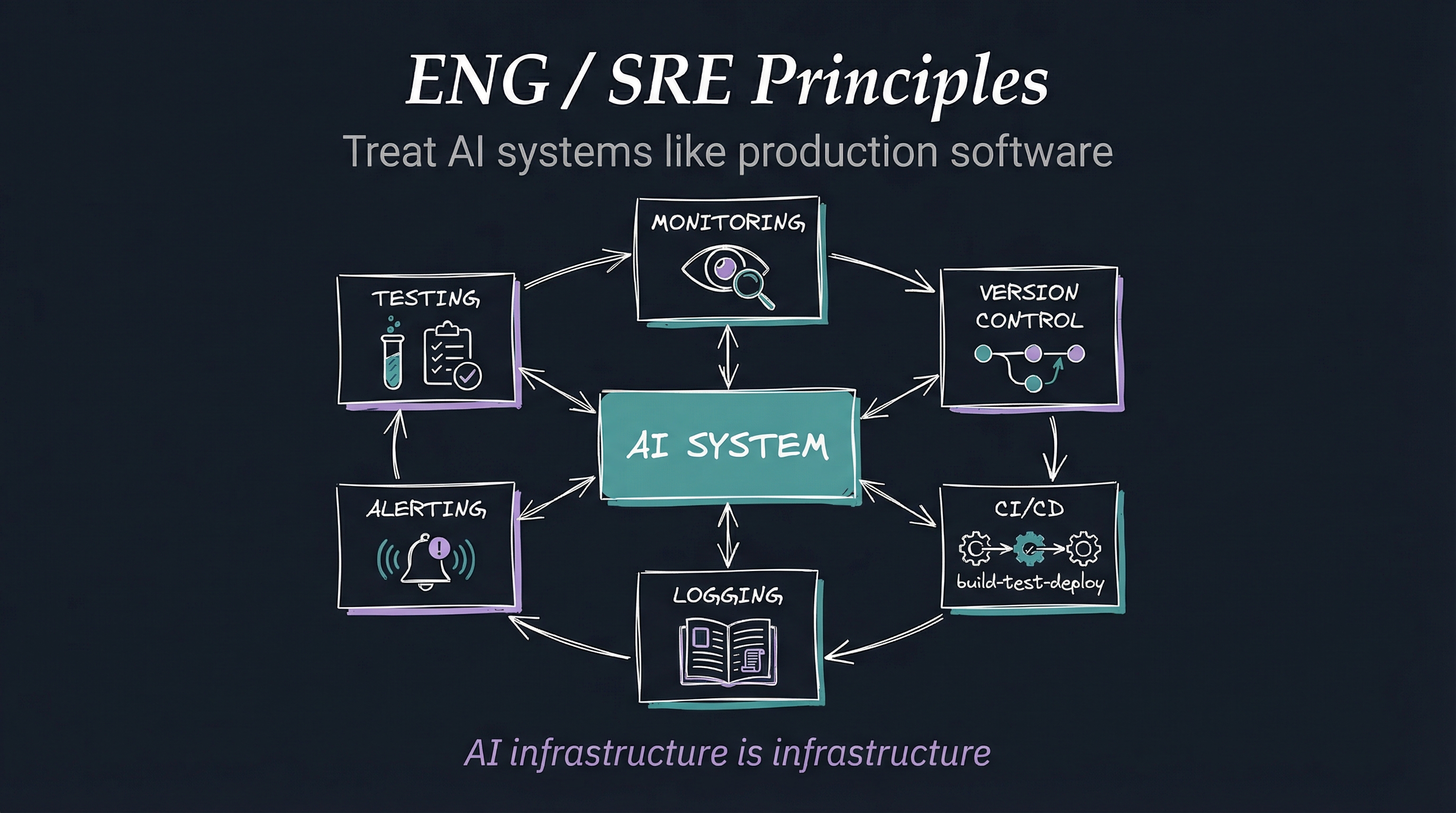
Apply software engineering and site reliability practices to AI systems. AI infrastructure is infrastructure—treat it with the same rigor.
This isn’t about over-engineering hobby projects. It’s about recognizing that AI systems running in production face the same challenges as any production system: failures, debugging, monitoring, version control, rollbacks.
Engineering and SRE principles aren’t optional luxuries for “later.” They’re fundamental requirements for systems you actually depend on.
Why This Matters
AI systems fail - Models hallucinate, APIs time out, rate limits hit, context windows overflow. Without SRE practices, you’re debugging blind.
Production demands reliability - “Works on my machine” is acceptable for prototypes. Production systems need monitoring, alerting, graceful degradation.
Maintenance is continuous - AI platforms change constantly. Without version control and rollback capabilities, updates are terrifying.
Debugging requires observability - When things break (and they will), you need logs, traces, and metrics. Hope is not a debugging strategy.
Scale reveals problems - What works for 10 requests fails at 10,000. SRE practices prevent you from discovering this the hard way.
Implementation
LifeOS applies engineering rigor throughout:
Version Control - Everything in git. Skills, configurations, prompts, workflows. History is complete. Rollbacks are trivial.
Observability Dashboard - Real-time agent monitoring at .claude/Skills/Observability/. WebSocket streaming, event timelines, pulse charts, swim lanes. You can see what your AI is doing.
Automated Testing - Tests run on every change. Failed tests block deployment. Self-test validation system verifies health.
Configuration Management - Explicit separation: settings.json for identity/paths, .env for API keys. Configuration is versioned and portable.
Error Handling - Progressive fallback (BrightData’s 4-tier scraping). Graceful degradation when services fail.
Security Protocols - .claude/Skills/CORE/SecurityProtocols.md defines handling of credentials, API keys, sensitive data.
Protection System - .pai-protected.json manifest prevents accidental modification of core files. Pre-commit hooks validate protected files.
Deployment Pipeline - Automated deployment through hooks. Staging before production. Rollback procedures defined.
Examples
Example 1: Observability Without SRE:
- AI agent hangs → no visibility into what’s happening
- Check logs manually → nothing useful
- Kill process, try again → same problem
- Give up, file a bug report
With SRE:
- AI agent hangs → Observability dashboard shows exact workflow stuck
- Event timeline reveals API timeout in third-party service
- Metrics show rate limit hit
- Graceful fallback activates, system recovers
- Root cause identified, permanent fix deployed
Example 2: Version Control + Rollback Without SRE:
- Update skill, breaks production
- Don’t remember what changed
- Try to fix forward → make it worse
- System unusable for hours
With SRE:
- Update skill, breaks production
git revert HEAD→ instant rollback- System operational in 30 seconds
- Debug the issue offline
- Deploy fixed version with confidence
Example 3: Automated Testing Without SRE:
- Modify core system file
- Think it works, push to production
- Breaks three unrelated skills
- Discover in production when users complain
With SRE:
- Modify core system file
- Automated tests run
- Three skill tests fail immediately
- Fix issue before deployment
- Production unaffected
Related Principles
- Principle #5: Spec / Test / Evals First - Testing is fundamental engineering
- Principle #3: As Deterministic as Possible - Determinism enables reliability
- Principle #12: Custom History System - History provides observability