Overview
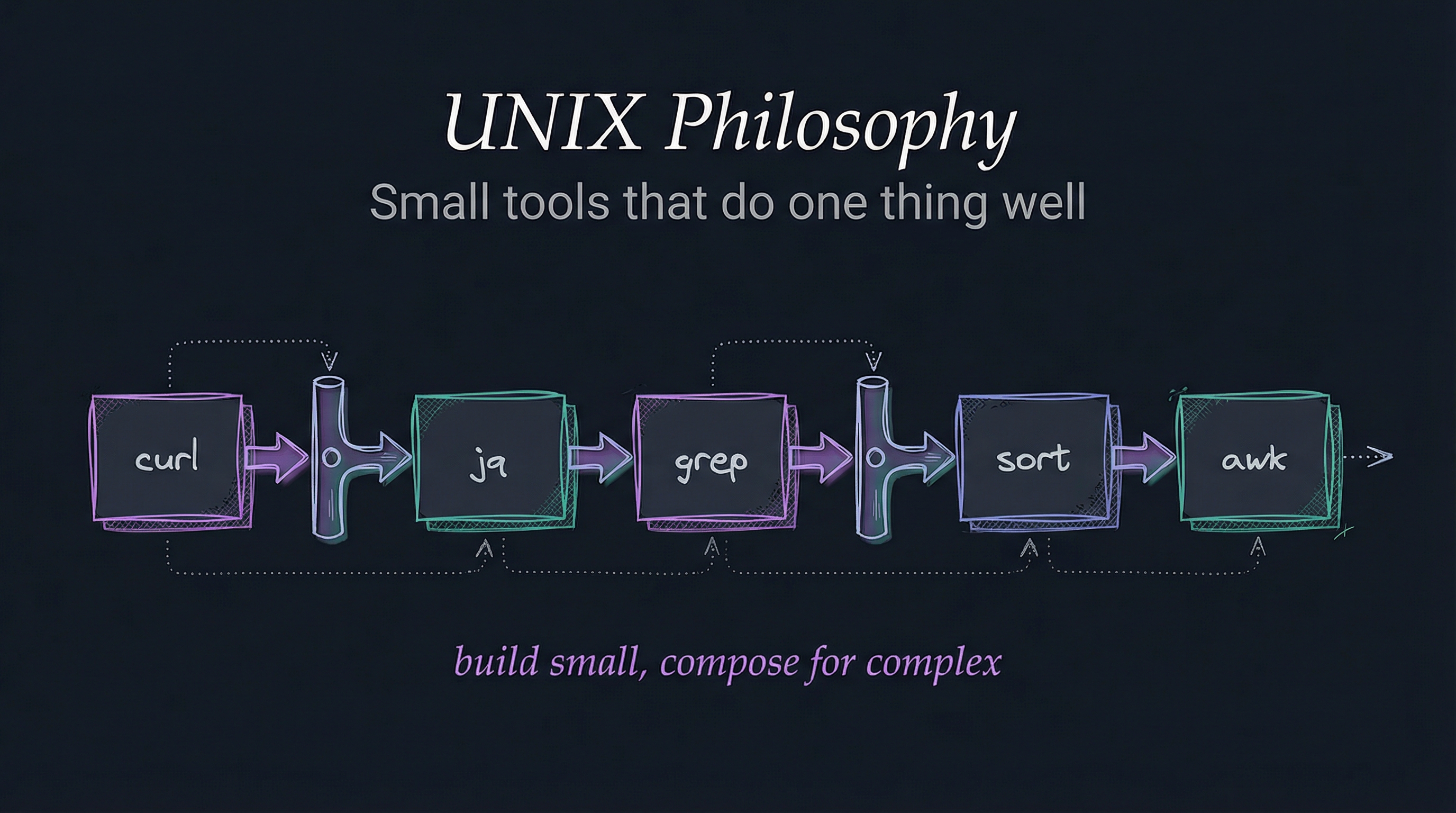
Do one thing well. Compose tools through standard interfaces. Build small, focused tools—compose them for complex operations.
The UNIX philosophy from the 1970s remains the best architectural pattern for reliable systems: small programs that do one thing well, connected through simple interfaces (pipes, files, standard streams).
This applies perfectly to AI infrastructure. Skills are self-contained packages that chain into complex workflows. Each skill does one thing. Workflows compose skills.
Why This Matters
Small tools are testable - You can’t meaningfully test a monolith that does everything. You can thoroughly test a tool that does one thing.
Small tools are reusable - A tool that does one thing well gets used in dozens of contexts. A tool that does many things poorly gets used nowhere.
Small tools are replaceable - When a better solution appears, you swap one small component. With monoliths, you rewrite everything.
Composition creates flexibility - Ten small tools can combine into thousands of workflows. One large tool has one workflow.
Small tools are understandable - You can hold a focused tool in your head. Monoliths require documentation, diagrams, and institutional knowledge.
Implementation
LifeOS implements UNIX philosophy through skills-as-containers:
Each skill is self-contained - Skills live in isolated directories with routing, workflows, context, tools, and documentation. No cross-skill dependencies.
Standard interfaces - Skills expose CLI commands (text in, text out). MCP provides standardized tool access. Everything composes through well-defined interfaces.
Skills compose via workflows - The Research skill composes multiple AI researchers in parallel. The Art skill composes diagram generation + optimization. BrightData composes four scraping tiers.
CLI as universal interface (Principle #8) - Every skill exposes command-line tools. CLI is the “pipe” that connects everything.
Skills System document - .claude/Skills/CORE/SkillSystem.md is the canonical guide for creating focused, single-purpose skills.
Examples
Example 1: Research Workflow Instead of a monolithic “research everything” tool:
extract-contentskill: Gets clean text from URLsfabric/extract_wisdompattern: Extracts key insightsfabric/summarizepattern: Condenses informationresearch/analyzeworkflow: Orchestrates all three
Each component does one thing. The workflow composes them.
Example 2: Content Pipeline Instead of “generate content” monolith:
art/generate-diagram- Creates technical diagramsart/optimize-image- Compresses for webblog/add-header- Formats for CMSblog/deploy- Pushes to production
Four focused tools, one complete pipeline.
Example 3: Data Processing UNIX way:
cat data.json | jq '.users' | grep "active" | wc -lEach tool does one thing:
cat- Read filejq- Parse JSONgrep- Filter textwc- Count lines
LifeOS skills work the same way—small, focused, composable.
Related Principles
- Principle #2: Scaffolding > Model - Modular scaffolding enables composition
- Principle #8: CLI as Interface - CLI provides standard composition interface
- Principle #11: Custom Skill Management - Skills are the organizational unit