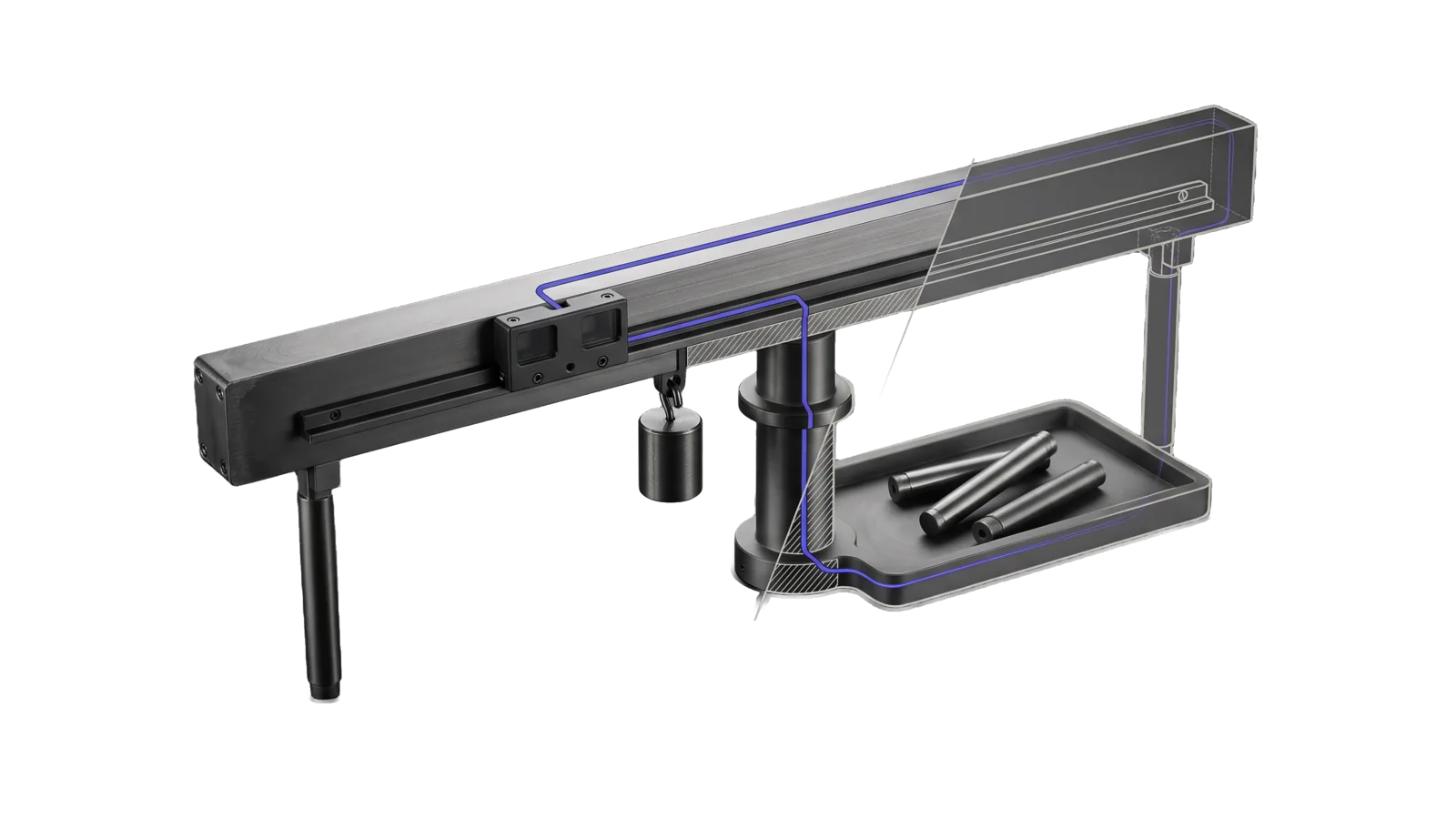
A long beam resting on a thick collared strut and slim struts, with three cut-away struts lying in a discard tray and a test weight hanging from its middle, cut diagonally so the far half of the beam and tray are drawn as ghosted outlines, with an indigo line running from the weight along the beam down the thick strut.
Other

BitterLessonEngineering

Audits any AI instruction set for over-prompting by asking whether a smarter model would make each rule unnecessary, then classifies every rule from CUT to KEEP

01
Workflow
00
Tools
00
References
08
Triggers

Key Points

Not for attacking logical flaws in ideas (RedTeam)

Inside the Skill

The thinking, frameworks, and architecture that distinguish this skill from a generic version of the same task.

Ideal State

  • Every audited rule is first sorted by kind under The First Sort below, and the report counts each kind. A preference is never cut, by judgment, score or ablation; a prescriptive step that is not a keep-class leaves as CUT or as REWRITE to the outcome it protects.
  • Every audited rule carries one classification from the table below with a one-line reason, and no keep-class rule (safety gate, verified gotcha, tool contract, output-format contract) is ever marked CUT.
  • No declarative content a model cannot derive (environment facts, domain invariants, API shapes, worked examples) is ever marked CUT; question 6 cuts imperative reasoning steps only.
  • No rule is cut as default behavior unless it is still default on the current model and the failure it was added for is truly gone.
  • Every report states its scope, the rule count and the verdict counts; a full audit also states estimated savings in lines and tokens.
  • The audited files change only after the user approves the trimmed versions.

Intent Routing

Intent Trigger File
Audit "audit setup", "full audit", "check all rules" Intents/Audit.md
QuickCheck "quick check", "check this file", "check these rules" Intents/QuickCheck.md

The First Sort

Whether a rule is BLE is decided by its kind, never by the length of the file it sits in (principal directive, 2026-10-25). Sort every rule into one kind before asking the Six Questions:

Kind What it says Verdict
Preference What the principal wants: an outcome, a taste, a word's meaning, who is trusted, which tool is ours KEEP. A smarter model still cannot know it. Questions 2, 3 and 5 may still MERGE, RESOLVE or SHARPEN it.
Move guard What must exist before a move is allowed: evidence before a fix or a close, an approval before a deploy, an independent mind before a verdict, a re-check before building on uncertain direction, who rules a contradiction KEEP, rigid. Its purpose is authority, accountability, independence, an external commitment or irreversibility, and a smarter model leaves each of those standing (author bias does not shrink with capability). System prompt § Rigid moves, free work.
Prescriptive step How to do something: an order of actions, a method, reasoning choreography CUT, or REWRITE as the outcome it protects, unless it is a move guard or safety gate
Verified gotcha A non-obvious failure of a tool or the install KEEP where it fires before the mistake; MOVE to tool once the tool can make the mistake impossible
Tool contract An exact command, path, flag or API shape KEEP, beside the outcome it serves
Safety gate / output-format contract An approval or destructive-op guard; a required deliverable shape KEEP

A with/without ablation measures steps, never preferences: most tasks never exercise a given preference, so an ablation scores it useless and would delete what only the principal could say.

The Six Questions

Ask each question of every rule, instruction, or preference found; a yes gives the verdict and action in its row.

# Question Verdict Action
1 Default behavior? Does Claude already do this without being told? CUT The model already does this.
2 Contradiction? Does it conflict with another rule in the same or a different file? RESOLVE Pick one, cut the other.
3 Redundancy? Is it already covered by a different rule or file? MERGE One location, one statement.
4 One-off fix? Was it added to fix one specific bad output rather than improve outputs generally? EVALUATE Still relevant, or already learned?
5 Vague? Would Claude interpret it differently every time (e.g., "be more natural", numeric personality scales)? SHARPEN Add specific DO/DON'T examples, or cut.
6 HOW instead of WHAT? Is it procedural over-prompting: does it dictate execution methodology or reasoning choreography ("first analyze X, then consider Y, then decide Z") instead of articulating the ideal state (WHAT done looks like) plus the tools? CUT Scaffolding, unless it is a keep-class or declarative content.

Two verdicts sit outside the questions. Content that is loaded but rarely actionable gets MOVE to on-demand: load it via the CLAUDE.md routing table when needed. A rule that is specific, actionable and non-default gets KEEP, which is what good instructions look like.

Declarative content is KEEP, never scaffolding: environment facts, domain invariants, API shapes and worked examples a model cannot derive. They state what is true, not how to reason, so question 6 does not reach them. Four keep-classes are legitimate HOW, never cut them: safety-gate (confirmation/destructive-op guard/approval), verified-gotcha (a documented non-obvious failure), tool-contract (exact CLI/API/path recipe), output-format-contract (required deliverable shape). Deterministic tools (*.ts) are exempt. A rule that survives "would a smarter model make this unnecessary?" is either a keep-class or genuine architecture. Infrastructure that makes output checkable (verification harnesses, ISC, data pipelines, routing rules) is architecture; machinery wrapped around the model's reasoning (CoT orchestrators, format parsers, retry cascades, process descriptions that aren't followed) is scaffolding. Full doctrine: LIFEOS/RULES/Philosophy.md § Ideal-State Prompting.

Gotchas

  • Process doctrine (the Algorithm, a release flow, an SOP) is mostly move guards, and they read like steps. On 2026-10-25 a first pass over the Algorithm marked "reproduce before fixing", "a fresh mind after two failed fixes" and "two re-calls, then the principal rules" as prescriptive steps to cut; all three are guards. Ask what the step protects before calling it method.
  • File length is not the finding. When OPERATIONAL_PREFERENCES.md was sorted on 2026-10-25, about 8 of its 359 rule lines were prescriptive steps; the rest were preferences, gotchas and tool contracts. An audit that reported "91 dated directives" as drift was wrong until it sorted them.
  • Cutting domain content as choreography costs quality: in the 2026-10-10 skill-quality A/B, FirstPrinciples lost −0.122 after its domain content was cut as methodology and won +0.089 once it was restored.
  • Startup context includes CLAUDE.md @-imports and the dynamicContext settings key (the full list of force-loaded sources is Intents/Audit.md § Inputs) — loadAtStartup was retired at v5.0's move to @-imports, and postCompactRestore no longer ships in any settings file. A reference to either in an instruction file is dead weight to flag, not a sync obligation.
  • Deterministic drift detection exists: bun ~/.claude/LIFEOS/TOOLS/SkillDriftLint.ts --dir skills/ [--strict] [--top N] (ported from @rpriven, public issue #1523). It is an advisory-only V1/V2 pattern scan: use it to find candidates mechanically, then judge each against the four keep-classes with this skill's questions. Drift grows back after every cut; the linter is the continuous check, this skill is the judgment.

Examples

Example 1: Full system audit

User: "Run BLE on my setup"
→ Audit intent
→ A categorized report over every force-loaded file with estimated token savings, trimmed versions offered for approval

Example 2: Check a single file

User: "Quick check this CLAUDE.md"
→ QuickCheck intent
→ A concise keep/cut/sharpen verdict for every rule in the file

Example 3: Post-cleanup validation

User: "I trimmed my rules, check if anything's still redundant"
→ Audit intent
→ Any surviving dead weight flagged against current Claude defaults

Workflows & Routing · 1

Each workflow is one job the skill runs. The trigger phrases route your request to the right one — this is the skill's routing table.

  1. 01
    Audit Intents/Audit.md

    audit setup, full audit, check all rules

How to Invoke

Say any of these to your DA and LifeOS activates the BitterLessonEngineering skill automatically:

  • "BLE"
  • "bitter lesson"
  • "audit setup"
  • "over-prompting"
  • "trim instructions"
  • "dead weight"
  • "simplify setup"
  • "clean up CLAUDE.md"

Or invoke explicitly:

Skill("BitterLessonEngineering")

Want LifeOS to do this for you?

Install LifeOS on your machine — your DA gets the BitterLessonEngineering skill plus 96 others, all hooked into one Life OS.