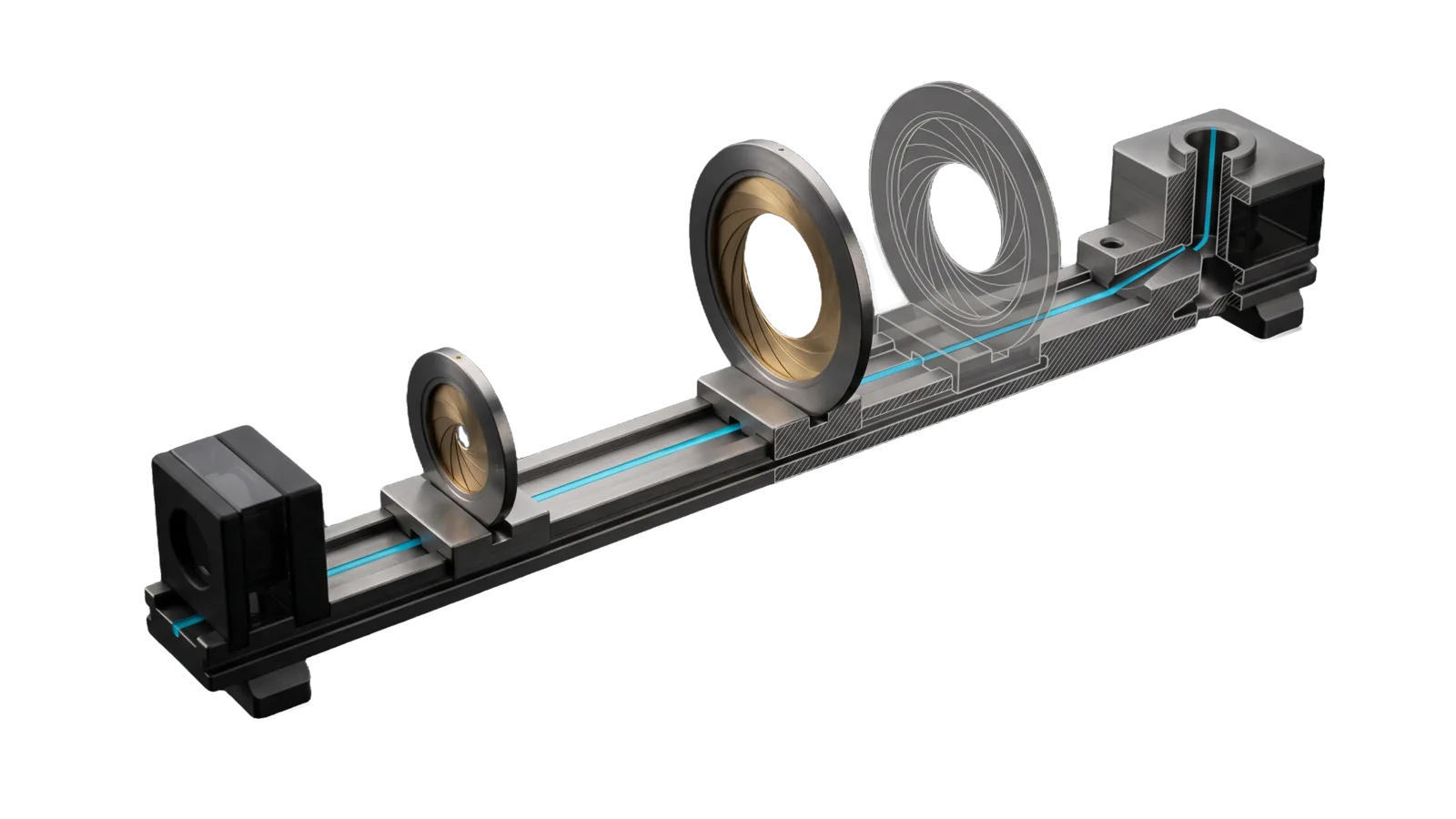
A machined optical rail with a fixed glass specimen block at one end and two sliding carriages carrying a small and a large iris ring, cut by a diagonal section plane through the far end where the merge block is drawn in bone-grey outline; a cyan channel runs along the rail through both irises and up into the merge block's outlet.
Creative

ApertureOscillation

3-pass scope oscillation that holds a question constant while shifting zoom — narrow/tactical, wide/strategic, then synthesis — to surface design tensions, scope recommendations, and coherence assessments invisible at any single zoom level

01
Workflow
00
Tools
00
References
10
Triggers

The Problem

When you ask an AI to design something specific — a caching layer, a new feature, an API shape — it optimizes for that thing in isolation. It thinks locally. The component comes out internally consistent but misaligned with what the broader system actually needs from it. You find this out mid-build, when the rework is expensive. A model with no scope-shifting mechanism can't tell you whether it's solving the right problem at the right zoom level.

How This Skill Approaches It

ApertureOscillation runs exactly three passes on the same question at different scope envelopes. Pass 1 (Narrow) treats the component as primary and captures its own internal logic — what it naturally wants to be. Pass 2 (Wide) treats the system vision as primary and derives what it needs the component to be. Pass 3 (Synthesis) feeds both outputs and finds where the tactical and strategic views diverge. That delta — design tensions, scope mismatches, alignment gaps — is the output. The Oscillate workflow is the single entry point; it requires two distinct inputs: a tactical target and a strategic context. When the two views agree, that's a finding too: build with conviction.

Not for lens rotation across angles (use IterativeDepth)

In Action

What you say to your DA, and what the ApertureOscillation skill actually does.

  • You say "oscillate scope on this — I'm adding webhook support to the Feed system, but it needs to fit inside Arbol"
    Runs the Oscillate workflow with webhook support as the tactical target and Arbol's action/function pattern as the strategic context. Produces three passes: what a standalone webhook service wants to be, what Arbol needs it to be, then the tension — standalone vs. Arbol action — with a concrete resolution.
  • You say "before I commit to this approach, check whether the tactical plan and the system vision actually agree"
    Runs Oscillate, narrow-then-wide on the proposed approach, surfaces any scope mismatch between local component logic and the broader system goal, and delivers a coherence assessment before any code is written.

Inside the Skill

The thinking, frameworks, and architecture that distinguish this skill from a generic version of the same task.

Ideal State

  • The principal gets a coherence verdict that changes or confirms a design decision before the build commits to it: a component that works alone but fights the system is caught at scoping, not after it ships.
  • Scope questions land here and angle questions land in IterativeDepth, so the two skills never run the same analysis twice.

Intent Routing

Intent Trigger File
Oscillate "aperture oscillation", "oscillate scope", "zoom in/out", "tactical vs strategic"; an Algorithm run selects the ApertureOscillation capability while scoping Intents/Oscillate.md

Gotchas

  • None reproduced yet. Add each real failure here, dated, with where it was seen.

Examples

Example 1: Feature design within a system

Tactical target: "Build a caching layer for session data"
Strategic context: "LifeOS is a Life OS that needs responsive, session-spanning AI assistance"

Pass 1 (Narrow): Redis with TTL, standard session cache patterns
Pass 2 (Wide): Cache must survive session boundaries, integrate with memory system, serve the Life OS vision
Pass 3 (Synthesis): Tension — standard session cache expires data that the Life OS needs to persist. Resolution: hybrid cache with session-scoped fast layer + memory-backed persistent layer.

Example 2: Architecture decision

Tactical target: "Add webhook support to the Feed system"
Strategic context: "Feed is one pipeline in Workflows, which processes content for a reader app"

Pass 1 (Narrow): Standard webhook receiver, queue, retry logic
Pass 2 (Wide): Webhooks must flow through Workflows' action/function pattern, integrate with existing queue infrastructure
Pass 3 (Synthesis): Tension — standalone webhook service vs. Workflows action. Resolution: implement as Workflows action, not standalone service, because the strategic context demands pipeline coherence over component independence.

Workflows & Routing · 1

Each workflow is one job the skill runs. The trigger phrases route your request to the right one — this is the skill's routing table.

  1. 01
    Oscillate Intents/Oscillate.md

    aperture oscillation, oscillate scope, zoom in/out, tactical vs strategic; an Algorithm run selects the ApertureOscillation capability while scoping

How to Invoke

Say any of these to your DA and LifeOS activates the ApertureOscillation skill automatically:

  • "aperture oscillation"
  • "oscillate scope"
  • "zoom in and out"
  • "tactical vs strategic"
  • "scope framing"
  • "design tension"
  • "system coherence check"
  • "local vs global design"
  • "wrong scope"
  • "scope negotiation"

Or invoke explicitly:

Skill("ApertureOscillation")

References & Credits

The thinkers, books, frameworks, and research this skill is built on. The ideas belong to them — the integration belongs to LifeOS.

Want LifeOS to do this for you?

Install LifeOS on your machine — your DA gets the ApertureOscillation skill plus 96 others, all hooked into one Life OS.