
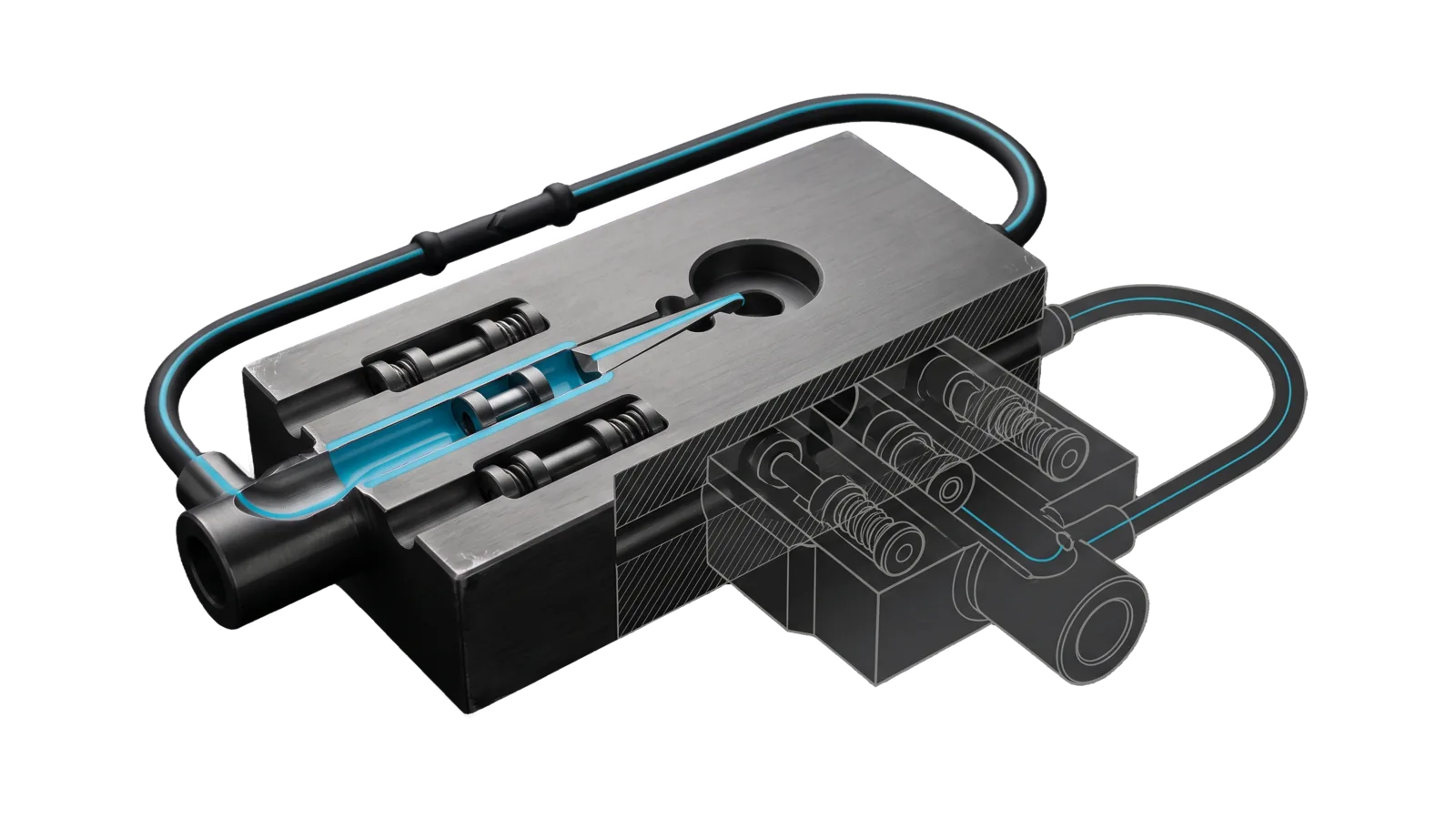
A rectangular valve block with three parallel bores, the middle bore lit cyan through its open valve and into a tapered needle seated in a round target socket, a return tube with one chevron looping back to the inlet, and the far end of the block drawn as bone-grey hatched section and outline.
Research

Science

The scientific method for understanding a problem: a goal locked before evidence, plural falsifiable hypotheses, and the cheapest evidence that tells them apart, from a timeboxed debug to a research-grade investigation

03
Workflows
00
Tools
04
References
11
Triggers

The Problem

Ask a generic AI to 'figure out why this is broken' and it guesses. One hypothesis, no experiment design, no measurement criteria — just pattern-matching toward a plausible answer. When the first guess is wrong, it guesses again with slight variation. There's no feedback loop, no falsification, no honest accounting of what the data actually showed. You get confident-sounding reasoning that collapses the moment you run it against reality.

How This Skill Approaches It

The skill embeds the scientific method as a literal execution loop: DefineGoal first (success criteria before any action), then GenerateHypotheses with a hard floor of three candidates (single-hypothesis work is confirmation bias by construction), DesignExperiment to make tests falsifiable, MeasureResults to collect only goal-relevant data, AnalyzeResults against the original success criteria, then Iterate back to the hypothesis phase. QuickDiagnosis applies this cycle in 15-minute bursts for fast debugging. StructuredInvestigation runs the full multi-factor version for complex problems. The skill integrates Council for hypothesis generation, Evals for structured measurement, and RedTeam for stress-testing conclusions before you commit to them.

Not for multi-angle lens passes (IterativeDepth) or measured improvement of a target (HillClimb)

In Action

What you say to your DA, and what the Science skill actually does.

  • You say "figure out why the surface time filters are showing stale items"
    Runs QuickDiagnosis: generates at least three hypotheses (timestamp format mismatch, cache invalidation gap, query boundary condition), designs a minimal test for each, runs them, compares results to the success criterion, and surfaces the structural cause — not just the first thing that looked suspicious.
  • You say "experiment with different prompt structures to get better output quality"
    Runs FullCycle: defines a measurable quality criterion, generates 3+ prompt variants as competing hypotheses, designs controlled experiments with the Evals skill as the measurement layer, analyzes which variant actually moved the metric, and iterates until the winner is confirmed or a new hypothesis enters the pool.
  • You say "how do we test whether adding a rate limit will actually reduce abuse"
    Runs DesignExperiment: frames the question as a falsifiable claim, identifies what data would confirm or refute it, defines the minimum viable test, and flags second-order effects (legitimate traffic retry load) that the hypothesis needs to account for before the experiment runs.

Inside the Skill

The thinking, frameworks, and architecture that distinguish this skill from a generic version of the same task.

Ideal State

  • Every investigation ties a goal locked before evidence collection to competing falsifiable hypotheses, and every verdict traces to evidence against those precommitted criteria.
  • Rigor matches the stakes: a quick diagnosis stays timeboxed, a complex problem leaves an auditable record, and a research-grade question gets pre-registration and independent review.
  • Goal achievement and hypothesis support are judged separately, null and inconclusive results stay visible, and every investigation ends in an explicit next action or stopping decision.
  • A question that turns into "make this measured number better" leaves Science for HillClimb with its goal and hypotheses attached.

Intent Routing

Intent Trigger File
DefineGoal "define the goal", "what are we trying to achieve" Intents/DefineGoal.md
QuickDiagnosis Quick debugging (15-min rule); not for an obvious five-minute fix or creative/generative work, which need no ceremony Intents/QuickDiagnosis.md
StructuredInvestigation "investigate", complex or research-grade investigation Intents/StructuredInvestigation.md

Experiment requests ("what might work", "how do we test", "iterate", "analyze the results", "optimize") on a target with a measurement go to HillClimb (skills/HillClimb/SKILL.md).

File Read when
Methodology.md running or measuring an investigation: execution invariants and tool routing
Protocol.md handing work to a specialist skill, sizing formality by scale, or receiving a stalled climb; also the contract a skill follows when its body says it implements the Science protocol
Templates.md a record's status values or its compact form
Examples.md interpreting improvement when the goal is still unmet, or an aggregate score against failed criteria

Data & Config

User customizations live at <configRoot>/LIFEOS/USER/CUSTOMIZATIONS/SKILLS/Science/ (configRoot is $CLAUDE_CONFIG_DIR when set, else ~/.claude). When that directory exists, its PREFERENCES.md, configurations and resources override the defaults here; when it is absent, the defaults stand.

Gotchas

No gotchas documented yet. Add failures here as they're discovered.

Examples

  • "Why is this test flaky?" → QuickDiagnosis: a one-sentence GOAL, H1-H3 with falsifiers, the cheapest discriminating test first.

  • "What might work to cut churn?" → HillClimb: churn is a measured product number, so it is a metric climb with its hypotheses, experiments and keeps in the climb ledger.

  • A weeks-long decision needing methodology review and statistical rigor → StructuredInvestigation at research grade: pre-registered goal, five or more hypotheses, independent review recorded.

Workflows & Routing · 3

Each workflow is one job the skill runs. The trigger phrases route your request to the right one — this is the skill's routing table.

  1. 01
    DefineGoal Intents/DefineGoal.md

    define the goal, what are we trying to achieve

  2. 02
    QuickDiagnosis Intents/QuickDiagnosis.md

    Quick debugging (15-min rule); not for an obvious five-minute fix or creative/generative work, which need no ceremony

  3. 03
    StructuredInvestigation Intents/StructuredInvestigation.md

    investigate, complex or research-grade investigation

How to Invoke

Say any of these to your DA and LifeOS activates the Science skill automatically:

  • "think about"
  • "figure out"
  • "diagnose"
  • "investigate"
  • "why is this happening"
  • "science"
  • "quick diagnosis"
  • "structured investigation"
  • "define the goal"
  • "what are we trying to achieve"
  • "research-grade investigation"

Or invoke explicitly:

Skill("Science")

References · 4

Auxiliary files the skill loads at runtime — frameworks, guides, configs.

  • Examples
  • Methodology
  • Protocol
  • Templates

References & Credits

The thinkers, books, frameworks, and research this skill is built on. The ideas belong to them — the integration belongs to LifeOS.

Want LifeOS to do this for you?

Install LifeOS on your machine — your DA gets the Science skill plus 96 others, all hooked into one Life OS.