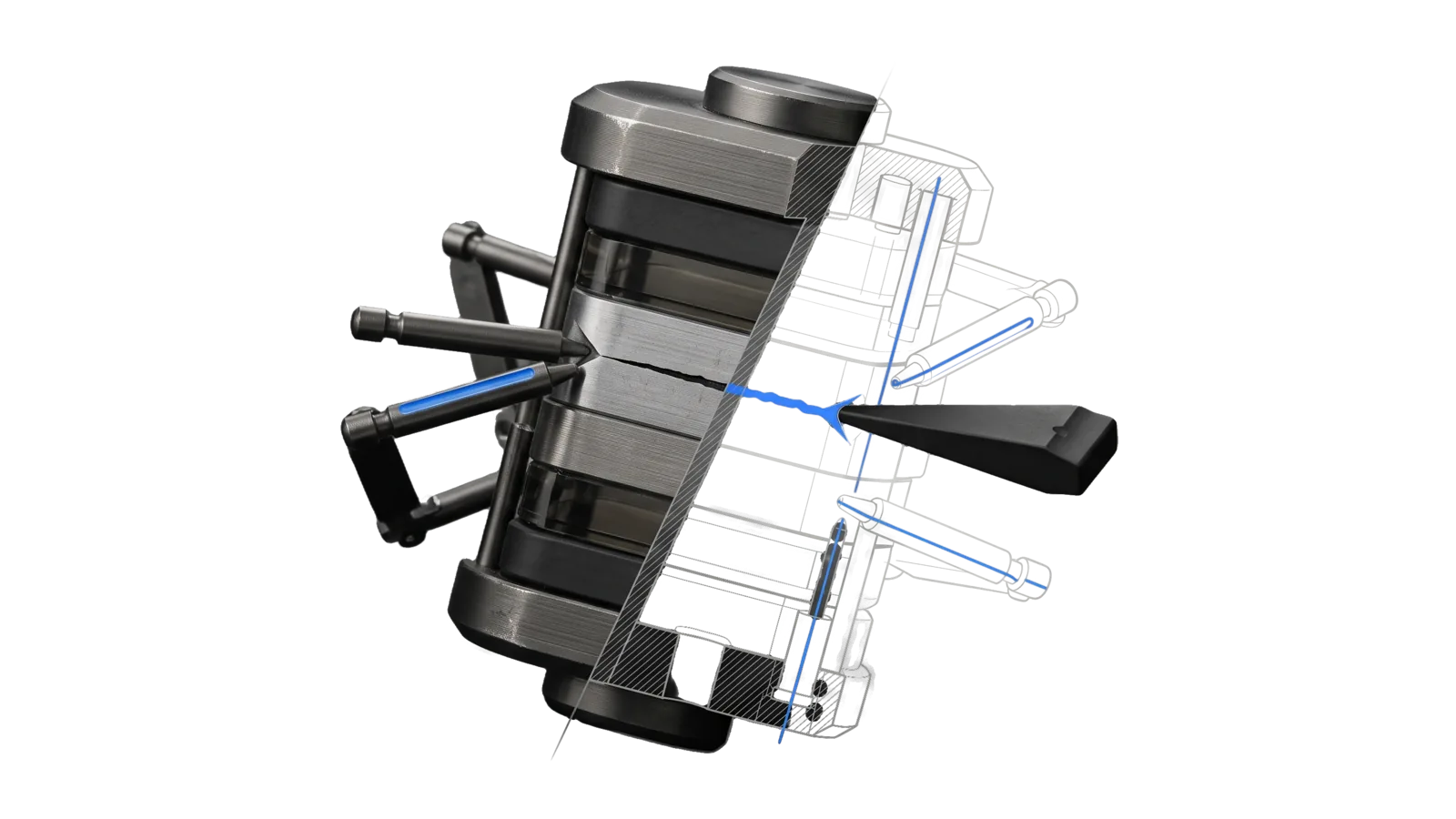
A column of stacked plates ringed by striker pins, cut open to show one plate cracked where a single blue-lit striker hit it, with a wedge needle resting on the crack.
Security

RedTeam

Adversarial analysis deploying parallel expert agents to stress-test ideas, strategies, and plans — attacks atomic claims, then steelmans and counter-argues, with severity-ranked findings and remediation; also tests an idea or investment against 11 persistent world models from 6 months to 50 years (Fast/Standard/Deep), and refreshes and reports on those models

05
Workflows
00
Tools
03
References
18
Triggers

The Problem

Ask a chatbot to 'stress-test this plan' and you get a bulleted list of generic concerns — the same concerns you already thought of. There's no real adversarial pressure because the model is optimizing to be helpful, not to break things. It produces objections that sound like objections but pull punches. A plan that needs to be challenged comes back with a gold star and mild suggestions.

How This Skill Approaches It

ParallelAnalysis breaks the input into 24 atomic claims, then runs 32 independent expert agents against them simultaneously — engineers, architects, pentesters, and interns, all attacking from different angles. The output isn't a list of concerns; it's a steelman of the strongest version of the argument and a devastatingly specific counter-argument with severity-ranked findings. AdversarialValidation runs competing proposals head-to-head and synthesizes the winner. Both workflows wire into Ideate's TEST phase and WorldThreatModel, so adversarial pressure fires automatically inside larger workflows. The goal is to find the one thing that could collapse the plan — then fix it before anyone else does.

Not for collaborative debate to find best path (use Council), or threat modeling your own estate (ThreatModel)

In Action

What you say to your DA, and what the RedTeam skill actually does.

  • You say "red team my decision to migrate the monolith to microservices this quarter"
    Runs ParallelAnalysis: decomposes the plan into 24 atomic claims, attacks each from 32 expert perspectives in parallel, surfaces the highest-severity structural risk, and returns a steelman plus an 8-point counter-argument with remediation paths.
  • You say "poke holes in this pricing strategy before I take it to the board"
    ParallelAnalysis identifies the one assumption the whole strategy rests on, surfaces three scenarios where the model breaks, and ranks findings by severity so you know what to address before the room does.
  • You say "battle these two architecture proposals and tell me which one wins"
    AdversarialValidation pits the proposals against each other, extracts what each gets right, and synthesizes a best solution that neither team wrote — with explicit reasoning for every decision kept or discarded.

Inside the Skill

The thinking, frameworks, and architecture that distinguish this skill from a generic version of the same task.

Ideal State

  • Every attack lands on the argument's load-bearing claims, and the headline finding is the flaw that would collapse the structure, never a pile of nitpicks.
  • Findings are ranked by severity with noise discarded, each names the claim it breaks, and each weakness carries a remediation that fits the stated constraints.
  • Length follows the requested depth: a quick or inline pass returns the 4-6 strongest objections; a full stress test returns a steelman and a counter-argument (8 points each) from attackers split across model vendors; designing something new returns one synthesized solution from competing proposals.
  • When the caller says inline or no agents, nothing is dispatched: no Inference.ts call and no Agent spawn.
  • An idea tested through time gets a verdict at every one of the 11 horizons, stated as scenarios with probability ranges, never as predictions, at the tier asked for (Standard when none is named); any horizon or capability that failed is named in the result instead of vanishing.
  • Every world model it reads or writes lives under <configRoot>/LIFEOS/MEMORY/RESEARCH/WorldModels/ with a last_updated date, so how fresh a model is shows before an idea is tested against it.

Intent Routing

Intent Trigger File
ParallelAnalysis "red team this", "poke holes", "strongest objection", "quick adversarial pass", "inline, no agents": stress-test existing content Intents/ParallelAnalysis.md
AdversarialValidation "battle of bots", "which approach is better", "help me design/decide X": produce new content via competition Intents/AdversarialValidation.md
TestIdea "test idea", "test strategy", "test investment", "how will this hold up", "stress test against the future", "test against future", "threat model my bet", "world model": test any input against all 11 world models (6 months to 50 years), Fast/Standard/Deep Intents/TestIdea.md
UpdateModels "update world model", "update world models", "refresh models", "new analysis": refresh world model content with new research/analysis Intents/UpdateModels.md
ViewModels "view world model", "show models", "current models", "model status": read and summarize current world model state and freshness Intents/ViewModels.md
File Read when
Philosophy.md framing what a fundamental flaw looks like
Integration.md pairing RedTeam with Research, FirstPrinciples or ExtractWisdom
References/WorldModelTemplate.md creating or updating a world model document (UpdateModels)
References/WorldModelOutputFormat.md presenting TestIdea results, at any tier
Setup.md first-time setup: building the 11 world models the time-horizon lane needs, and what the cross-vendor runs use

World Model Storage

Models are stored at <configRoot>/LIFEOS/MEMORY/RESEARCH/WorldModels/: INDEX.md (summary of all models with last-updated dates) and one horizon file each, 6-month.md, 1-year.md, 2-year.md, 3-year.md, 5-year.md, 7-year.md, 10-year.md, 15-year.md, 20-year.md, 30-year.md, 50-year.md. Scenario models (alternative futures) live in <configRoot>/LIFEOS/MEMORY/RESEARCH/WorldModels/Scenarios/.

Data & Config

User customizations, when present, live at <configRoot>/LIFEOS/USER/CUSTOMIZATIONS/SKILLS/RedTeam/ (configRoot is $CLAUDE_CONFIG_DIR when set, else ~/.claude). Any PREFERENCES.md, configurations, or resources there override the defaults; when the directory does not exist, proceed with skill defaults.

First-time setup (building the world models, the vendors a full run uses) is in Setup.md.

Gotchas

  • Update models when major world events occur. Static threat models decay in accuracy. For the world models, TestIdea warns past 30 days and flags past 90.
  • Scale the fan-out to the claim count — more agents generate more volume, not more signal. Not all findings are equal: rank by severity, discard noise.
  • Subagents attacking judgment-layer question sets often may not spawn agents and ask for an inline pass. Their attack lenses were literal readings, look-alike inputs, injection through untrusted fields, averaging, and rule-order shadowing.

Examples

Attack an architecture proposal:

User: "red team this microservices migration plan"
--> Intents/ParallelAnalysis.md
--> Returns steelman + devastating counter-argument (8 points each)

Devil's advocate on a business decision:

User: "poke holes in my plan to raise prices 20%"
--> Intents/ParallelAnalysis.md
--> Surfaces the one core issue that could collapse the plan

Quick inline pass from a subagent:

User: "Quick inline pass, no agents: attack this judgment-layer question set for literal readings, look-alikes and injection"
--> Intents/ParallelAnalysis.md
--> The 4-6 strongest objections, severity-ranked, each with the claim it breaks and a fix

Stress-test a bet through time:

User: "threat model my bet on AI-first content creation, deep"
--> Intents/TestIdea.md at the Deep tier
--> Per-horizon verdicts, Cross-Horizon Synthesis and a Council Deliberation section

Check world model freshness:

User: "show me the world models"
--> Intents/ViewModels.md
--> INDEX table with a freshness label per horizon and the models that need a refresh

Adversarial validation for content:

User: "battle of bots - which approach is better for this feature?"
--> Intents/AdversarialValidation.md
--> Synthesizes best solution from competing ideas

Workflows & Routing · 5

Each workflow is one job the skill runs. The trigger phrases route your request to the right one — this is the skill's routing table.

  1. 01
    ParallelAnalysis Intents/ParallelAnalysis.md

    red team this, poke holes, strongest objection, quick adversarial pass, inline, no agents: stress-test existing content

  2. 02
    AdversarialValidation Intents/AdversarialValidation.md

    battle of bots, which approach is better, help me design/decide X: produce new content via competition

  3. 03
    TestIdea Intents/TestIdea.md

    test idea, test strategy, test investment, how will this hold up, stress test against the future, test against future, threat model my bet, world model: test any input against all 11 world models (6 months to 50 years), Fast/Standard/Deep

  4. 04
    UpdateModels Intents/UpdateModels.md

    update world model, update world models, refresh models, new analysis: refresh world model content with new research/analysis

  5. 05
    ViewModels Intents/ViewModels.md

    view world model, show models, current models, model status: read and summarize current world model state and freshness

How to Invoke

Say any of these to your DA and LifeOS activates the RedTeam skill automatically:

  • "red team"
  • "attack idea"
  • "counterarguments"
  • "critique"
  • "stress test"
  • "devil's advocate"
  • "find weaknesses"
  • "break this"
  • "poke holes"
  • "strongest objection"
  • "world threat model"
  • "world model"
  • "test idea against the future"
  • "how will this hold up in 10 or 20 years"

Or invoke explicitly:

Skill("RedTeam")

References · 3

Auxiliary files the skill loads at runtime — frameworks, guides, configs.

  • Integration
  • Philosophy
  • Setup

Want LifeOS to do this for you?

Install LifeOS on your machine — your DA gets the RedTeam skill plus 96 others, all hooked into one Life OS.