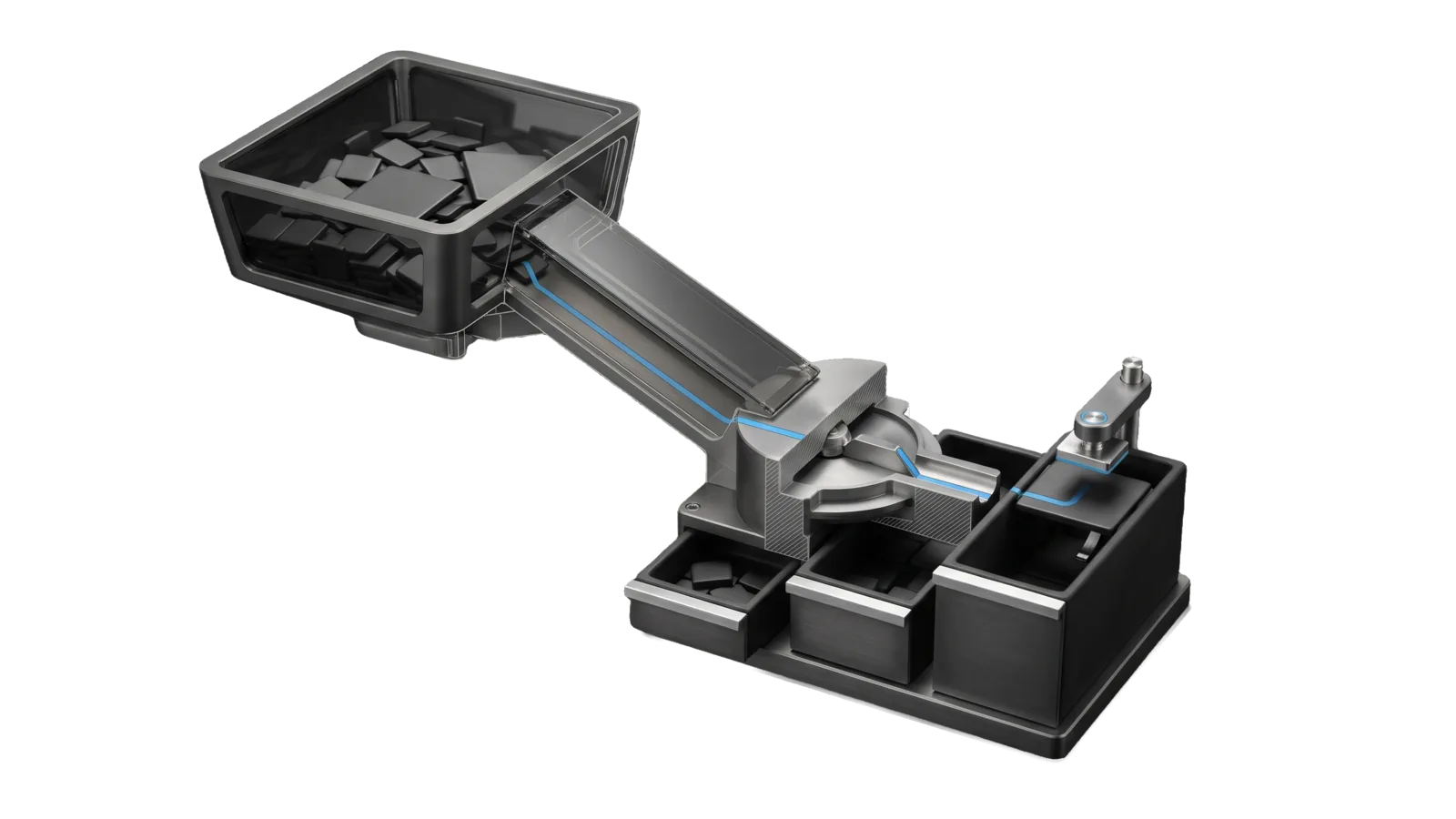
A glass-sided hopper heaped with small flat tabs feeds a diagonal chute into a rotary diverter block, below which stand three open drawers of short, medium and tall height with a stamp arm over the tallest, the hopper's lower edge drawn in bone-grey line, and a sky-blue line running from the hopper's throat down the chute through the diverter into the tall drawer.
Development

OpenSourceManagement

Triages open issues, pull requests and GitHub Discussions across the principal's own open-source repos (the list in Config.md) via the gh CLI, ranks what needs attention with suggested replies, posts edit-in-place marker comments, diffs new Ollama library models against a local model box, and takes a private repo public (readiness audit, fresh-history export, README and social image), stopping at the principal's go-ahead

07
Workflows
05
Tools
01
Reference
21
Triggers

Key Points

Not for triaging repos outside the configured list, LifeOS releases, internal work trackers, or running/prompting local models

Inside the Skill

The thinking, frameworks, and architecture that distinguish this skill from a generic version of the same task.

Ideal State

  • Every report comes from this session's live gh fetch, structured per repo, with items ranked by urgency and impact, each repo's community mood rated (positive, neutral, negative), and specific next actions with suggested responses, written direct and actionable.
  • A fetch that failed or hit its limit is named as a hole or a truncation, never rendered as a quiet repo.
  • No public "fixed", "merged" or "done" claim goes out before the change lands in the source of truth (Gotchas: FIX-IN-SOURCE-FIRST), and a recurring bot note is one marker comment edited in place, never a stack.
  • A private repo goes public only as an audited, fresh-history export that reads READY, with a problem-first README, a license and a social preview image, and only on the principal's word naming that repo.
  • Local-model checks name what is new in the Ollama library, whether each fits and is already on the local model box, and leave every pull to the principal.

Intent Routing

Intent Trigger File
CheckIssues "check issues", "open source issues", " issues" Intents/CheckIssues.md
CheckPullRequests "check PRs", "pull requests", "review PRs", "open PRs" Intents/CheckPullRequests.md
CheckDiscussions "check discussions", "community discussions", "what are people asking" Intents/CheckDiscussions.md
CheckState "open source state", "project state", "check our open source", "what needs attention" Intents/CheckState.md
PostMarkerComment "post triage comment", "leave a marker comment", "edit-in-place comment", "update bot comment", "upsert comment" Intents/PostMarkerComment.md
LocalModels "new open source models", "latest open-weight models", "what should I pull", "do we have ", "new Ollama models" Intents/LocalModels.md
GoPublic "is X public-ready", "take this repo public", "open source this", "prep X for public release" Intents/GoPublic.md
File Read when
Tools/ Tools/Fetch.help.md holds the triage fetch's kinds, flags, config keys and hole semantics; Tools/LocalModels.help.md holds LocalModels flags and column semantics; Tools/PublicReady.help.md holds every public-readiness check and the export contract
Setup.md first-time setup: Config.md keys, the gh login, the optional model host, a proof command

Repos

The repos come from Config.md, never from this skill:

OSS_OWNER: <github login or org>
OSS_REPOS: <repo>, <repo>, <repo>
OSS_PRIORITY: <repo>        # optional: triaged first in batch work

Tools/Fetch.ts reads OSS_OWNER and OSS_REPOS at run time and loops over the list in the order written; --repo <name> narrows to one listed repo and refuses any other. Every intent's per-repo section repeats once per listed repo. Config.md § Source of truth and § Out of scope carry the per-repo routing the gotchas below rely on.

Quick Reference

# The one live fetch every triage intent pre-injects (JSON; a failed call is a hole, never an empty list)
bun ~/.claude/skills/OpenSourceManagement/Tools/Fetch.ts <issues|prs|discussions|stats>... [--repo <name>] [--limit N] [--brief]

# Marker-backed comment upsert (edit-in-place, never stack)
bun run ~/.claude/skills/OpenSourceManagement/Tools/MarkerComment.ts \
  upsert <owner>/<repo> <number> <marker-id> <body-file> [--dry-run]
bun run ~/.claude/skills/OpenSourceManagement/Tools/MarkerComment.ts \
  find <owner>/<repo> <number> <marker-id>

# Is a repo safe to publish, and its clean fresh-history export (never pushes)
bun ~/.claude/skills/OpenSourceManagement/Tools/PublicReady.ts audit <repo> [--json] [--no-build]
bun ~/.claude/skills/OpenSourceManagement/Tools/PublicReady.ts export <repo> --out <empty-dir>

# Newest Ollama library models vs the local model box (host from Config.md)
bun ~/.claude/skills/OpenSourceManagement/Tools/LocalModels.ts [--json] [--limit N] [--host <ssh>] [--local]

Data & Config

Everything install-specific lives in LIFEOS/USER/CUSTOMIZATIONS/SKILLS/OpenSourceManagement/Config.md; first-time setup and a proof command are in Setup.md.

  • OSS_OWNER, OSS_REPOS, OSS_PRIORITY — KEY: value lines; Tools/Fetch.ts reads the first two.
  • ## Source of truth — prose naming any listed repo that is generated or synced from another tree, and where that tree is. Read it before any fix.
  • ## Out of scope — prose naming repos this skill must not triage and where they go instead.
  • ## Local Model Host — the local model box's ssh alias and ollama binary; Tools/LocalModels.ts reads that table at run time; no hostnames live in this skill.

When OSS_OWNER or OSS_REPOS is missing, Fetch.ts prints an ERROR: line and fetches nothing; point the principal at Setup.md.

Gotchas

  • FIX-IN-SOURCE-FIRST. Every accepted change — a PR merge, an issue fix, a discussion-driven change — lands in the code's actual source of truth BEFORE any public "fixed/merged/done" response. The two halves are one action: fix in source + respond publicly. Source-of-truth routing comes from Config.md § Source of truth:
    • A repo not named there is its own source of truth: direct merges on the public repo stand. If the change also touches a local copy Config.md says mirrors that repo (vendored code, docs or tools that reference it), update the local copy in the same pass.
    • A repo named there as generated or synced from another tree (a release script that rebuilds the public repo from a private source, for example) never takes a merge on the public repo: port the change into the named source first, credit the contributor, and close the PR; the next sync carries it. A change made only on the public repo is wiped by the next sync.
    • "Already fixed" closes require verifying the fix is present in the source of truth this session (Read/diff evidence), not just absent from public main.
  • Covers the OSS_REPOS list only. Not every repo the owner has; a repo in Config.md § Out of scope goes where that section says.
  • Community sentiment can be negative during breaking changes. Frame triage responses constructively.
  • Batch work starts with OSS_PRIORITY when it is set, usually the repo with the most community activity.
  • Use marker comments for any rolling bot-authored note. The default gh issue comment posts a new comment every time — wrong for triage status, weekly digests, per-PR summaries. Reach for PostMarkerComment instead. Marker IDs must be <intent>-<purpose> and unique per (issue, kind); two intents MUST NOT share a marker on the same issue or they will overwrite each other.
  • LocalModels scrapes ollama.com HTML; there is no public JSON API for the library. Class names drift, and the served HTML splits tag attributes across lines, so the parser collapses ALL whitespace before matching; normalizing newlines alone leaves every size and capability blank. Every field is best-effort: a blank column is a parser miss, not a missing model. Fix the regex, never hard-fail.
  • A library model's VRAM fit is on total params, not active. MoE models load every expert. A 118B-A8B model is a 118B load.
  • Always --dry-run first against a public community repo. Comment bodies are public and permanent in the timeline even after edit. Inspect the body, confirm the marker ID, then drop --dry-run.

Examples

Example 1: Check all open source state

User: "Let's look at our open source issues"
→ Invokes CheckState intent
→ Fetches issues, PRs, discussions across every repo in OSS_REPOS
→ Analyzes sentiment and priority
→ Returns comprehensive state report with recommendations

Example 2: Check one repo's issues

User: "Check widget issues"   (widget is in OSS_REPOS)
→ Invokes CheckIssues intent
→ Fetches open issues from $OSS_OWNER/widget (--repo widget)
→ Categorizes by type (bug, feature, question)
→ Returns prioritized list with recommended responses

Example 3: Review pull requests

User: "Any PRs need attention on widget?"
→ Invokes CheckPullRequests intent
→ Fetches open PRs from $OSS_OWNER/widget
→ Summarizes each PR's purpose and status
→ Recommends which to merge, review, or discuss

Workflows & Routing · 7

Each workflow is one job the skill runs. The trigger phrases route your request to the right one — this is the skill's routing table.

  1. 01
    CheckIssues Intents/CheckIssues.md

    check issues, open source issues, <repo> issues

  2. 02
    CheckPullRequests Intents/CheckPullRequests.md

    check PRs, pull requests, review PRs, open PRs

  3. 03
    CheckDiscussions Intents/CheckDiscussions.md

    check discussions, community discussions, what are people asking

  4. 04
    CheckState Intents/CheckState.md

    open source state, project state, check our open source, what needs attention

  5. 05
    PostMarkerComment Intents/PostMarkerComment.md

    post triage comment, leave a marker comment, edit-in-place comment, update bot comment, upsert comment

  6. 06
    LocalModels Intents/LocalModels.md

    new open source models, latest open-weight models, what should I pull, do we have <model>, new Ollama models

  7. 07
    GoPublic Intents/GoPublic.md

    is X public-ready, take this repo public, open source this, prep X for public release

Tools · 5

Deterministic executables the workflows call — the code that does the real work, not prompt scaffolding.

  • Fetch.ts
  • LocalModels.ts
  • LocalModelsLib.ts
  • MarkerComment.ts
  • PublicReady.ts

How to Invoke

Say any of these to your DA and LifeOS activates the OpenSourceManagement skill automatically:

  • "open source issues"
  • "pull requests"
  • "check PRs"
  • "review PRs"
  • "check issues"
  • "community discussions"
  • "community activity"
  • "what needs attention"
  • "open source state"
  • "marker comment"
  • "triage comment"
  • "new open source models"
  • "latest open-weight models"
  • "what should I pull into Ollama"

Or invoke explicitly:

Skill("OpenSourceManagement")

References · 1

Auxiliary files the skill loads at runtime — frameworks, guides, configs.

  • Setup

Want LifeOS to do this for you?

Install LifeOS on your machine — your DA gets the OpenSourceManagement skill plus 96 others, all hooked into one Life OS.