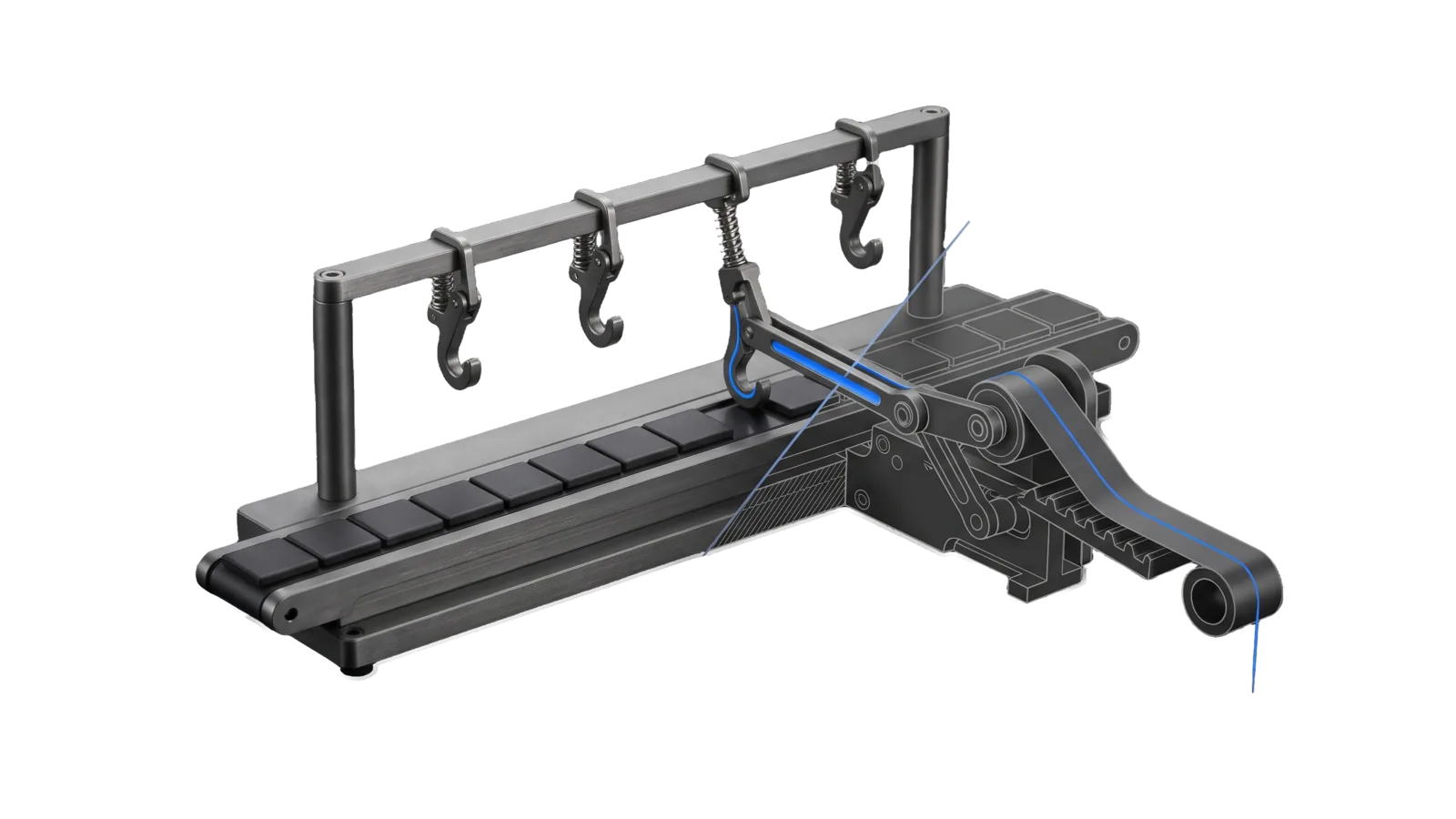
A conveyor of identical dark tiles under a bar carrying four spring hooks, three raised and one dropped to catch a tile; a linkage arm from the engaged hook reaches a roller that draws a banner strip out toward a ring terminal, drawn as ghosted outline past a thin diagonal cut, with one blue line along the linkage.
Development

LifeOSHooks

The LifeOS function-hook plugin: check it is armed, explain why a line or banner was or was not drawn, regenerate its types after a Claude Code update, sync pure-core copies, run its probes

00
Workflows
00
Tools
01
Reference
11
Triggers

Key Points

Not for the command hooks under hooks/ (edit directly), the Pulse dashboard (Pulse), or Relay diagnostics (the relay skill)

Inside the Skill

The thinking, frameworks, and architecture that distinguish this skill from a generic version of the same task.

Ideal State

  • A status answer ("is the plugin loaded and working") says armed or not, on which build, and names its evidence: this session's stamp in MEMORY/STATE/function-hooks/<session>.json (the command hooks read it to go quiet on the lines the plugin draws), hooks/lib/build.ts, and for a headless check the probe's debug log. A verdict with no evidence fails.
  • The check holds the plugin to its standing properties: armed in every interactive session on the declared build, and in a headless session (-p, the SDK, Relay) every hook a passthrough with nothing drawn.
  • A "why did or didn't this draw" answer names the surface that owns the line (§ References) and the cause it found; a guess is labelled as one.
  • After a Claude Code update, .claude/types/claude-code.d.ts was written by the running build, hooks/lib/build.ts names that build, and the typecheck and tests pass; the answer names the old and the new build.
  • claude plugin validate <plugin dir> passes; its hooked-events list matches the ISA's closed criteria (/ic checks this).
  • The pure-core copies under hooks/lib/ equal their sources (tests/parity.test.ts; source tree only, not in the public release payload).

Anti-criteria

  • No diagnostic $.ui.log line is ever added to the live module, not even for one probe run. In any session that loads the edited module (§ Gotchas, reload), every $.ui.log line prints into the principal's transcript: one temporary diagnostic line, printed once per tool call, filled the screen (2026-10-02). Probe in a copy run with claude --plugin-dir <copy> and --debug-file, or put the diagnostic in pushEvent, which only reaches the events log.
  • A report never tells the principal a save already reloaded an open session; a check of a change in a live session starts with /reload-plugins (2026-10-11: a pane removed on disk kept drawing its old text in open sessions until a reload).

Intent Routing

This skill is its own single intent; its context files:

File Read when
References/ModuleGotchas.md editing the hooks module, or a draw, repaint or hand-over question the § References list below does not answer: engine API shapes, registration rules, scrollback and repaint behaviour
Setup.md installing the plugin on a new machine, or filling in this install's loading topology in the USER Config.md

Tool contract

  • Validate: claude plugin validate <plugin dir> (lists every hooked event and $ call).
  • Typecheck: cd <plugin dir> && bunx tsc --noEmit -p tsconfig.json.
  • Tests (source tree only; they are not in the public release payload): cd <plugin dir> && bun test ./tests. Running them from the install root hit EMFILE (2026-10-01).
  • Sync cores after editing a source: bun <plugin dir>/scripts/SyncCores.ts.
  • After a Claude Code update: the plugin declarations are Claude Code's own and never ship with the plugin; each install generates its own from the build it runs. /plugin-types is gone since 2.1.287, so the source is the running build's plugin-authoring skill, which provides that build's declarations when it loads: put them at .claude/types/claude-code.d.ts (their first line names the build), set TYPES_BUILD in hooks/lib/build.ts, typecheck, and run the tests (2026-10-01). The MCP declarations (.claude/types/claude-code-mcp.d.ts) copy connector tool descriptions verbatim, and some connectors (Slack) embed the logged-in account's user id in them; replace any such id with <slack-user-id> before the file is committed (2026-10-13).
  • Headless probe: claude -p "Reply OK." --plugin-dir <plugin dir> --debug-file <log> --max-turns 1, then grep the log for settled and failed to load.
  • Host I/O from the module goes only through LIFEOS/TOOLS/HookBridge.ts <verb>.

Setup

Needs Claude Code at or above the build named in hooks/lib/build.ts (MIN_BUILD) and bun. The plugin holds no personal data; its one user setting is forceBackground in its plugin manifest (.claude-plugin/plugin.json, or the marketplace entry when the install keeps the manifest there), off by default.

  1. Load it. Either put this folder under the skills directory, where Claude Code loads it as LifeOSHooks@skills-dir and hot-reloads it on every save, or list it in a folder marketplace (claude plugin marketplace add <folder>, then claude plugin install <name>@<marketplace>) and disable the skills-dir copy so only one loads.
  2. Record how it loads: with a folder marketplace, fill in <configRoot>/LIFEOS/USER/CUSTOMIZATIONS/SKILLS/LifeOSHooks/Config.md (marketplace, mods loaded from it, disabled skills-dir copies, reload consequence); Setup.md § Fill in documents every line. Loaded straight from the skills folder, the file is optional.
  3. Check it: claude plugin validate <plugin dir>, then the headless probe in § Tool contract. Success is a settled line and no failed to load line in the debug log.

References

Which surface owns each line and decision. Build-specific numbers live in the ISA (redraw timers, scan counts) and in the module constants (the reaper interval: hooks/LifeOSHooks.ts TREE_MS).

  • Nothing in the answer block is drawn by the plugin: the banner is the model's own first line and the 🗣️ closer its last. Memory and health lines are logged, not drawn (the board pane that showed them was removed 2026-10-11), the interview chip is on the statusline, the ⚙️ ledger is logged, and the band above the prompt carries only the ISA chip.
  • The plugin toasts each ascent-state transition (the statusline draws the ascent strip), puts the Security Protocol and a data-class ceiling into every subagent brief. It no longer tags MCP and web results as data or marks the session after an outside read (retired 2026-10-24; the Security Protocol governs outside content, see LIFEOS/DOCUMENTATION/Hooks/HookSystem.md § Native enforcement).
  • The plugin rewrites a Bash command in five ways, each shown on the tool row's dim mark: npm and npx become bun, an export LIFEOS_DISPATCH_ID=...; prefix binds a codex-backed run to its dispatch, git and gh status paths go through rtk, [REDACTED-SECRET-xxxx] tags are swapped back to the real values the principal's own prompt carried, and a subagent's commands are wrapped in sandbox-exec (macOS only, and only with LIFEOS_SUBAGENT_SANDBOX=on; otherwise they run unwrapped with a before-and-after detector).
  • Refusals: the plugin refuses sweeping git add, a plain git commit in the private trees, a gh comment with no agent attribution, and a WebFetch carrying a secret tag. Taint tracking (TaintGuard and the plugin's mark) retired 2026-10-24: no hook judges outbound Bash after an outside read; native permission rules hold the outbound actions. In a headless session the plugin is not armed and passes every call through.
  • Stray processes: every TREE_MS the poller hands LIFEOS/TOOLS/SessionTree.ts (the session-tree bridge verb) the feed's own agent statuses and stop times, plus its record of which subagent ran each Bash command. The reaper kills this session's orphaned and agent-stopped processes and writes the state file Vigil's running adapter reads. The 1 s agent poll writes each agent's one subagent_stop row. Nothing in LifeOS draws agents, workflows or running shells: Claude Code's /tasks, /workflows, agent panel, Bash pill and spinner show them (2026-10-11).
  • Routes: the DISPATCH line carries provider, model and reasoning effort from hooks/lib/route-label.ts. A mark is ✓ only on codex's own session log or the engine-resolved model (LIFEOS/TOOLS/RouteTrail.ts), and a helper run carries LIFEOS_DISPATCH_ID so it binds to its own dispatch.

Gotchas

  • Whether an open session runs the current module depends on how the plugin loaded. This install's loading topology (which marketplace, which mods, which skills-folder copy is disabled) is recorded in <configRoot>/LIFEOS/USER/CUSTOMIZATIONS/SKILLS/LifeOSHooks/Config.md (configRoot is $CLAUDE_CONFIG_DIR when set, else ~/.claude); read it before answering a reload question. A plugin loaded from a folder marketplace reaches no open session until /reload-plugins there (2.1.287+); claude plugin update reports "nothing to update" because it reads the folder at load (§ Anti-criteria holds the reporting rule). A plugin loaded straight from a skills folder (LifeOSHooks@skills-dir) is watched instead (plugin-authoring reference, 2.1.296): every save, from any session, hot-reloads the module in every open session and prints a <plugin>: reloaded (N hooks: …) line into each transcript. The marketplace wiring is a folder marketplace listing this folder by relative path (claude plugin marketplace add <folder>, then claude plugin install <name>@<marketplace>) with the <name>@skills-dir copy disabled in settings, so the module never loads twice; /ic plugin-load holds it wherever .claude-plugin/marketplace.json exists. Because the loaded module can lag the file, a native command hook never fast-exits on the bare stamp: it reads hookCovers(sid, cap), and the cap is written by HookBridge prompt-context, which only the module that hands the work over calls. Adding a new hand-over means adding a cap (hooks/lib/function-hooks.ts HookCap), never a stamp check.
  • Transcript redaction (ISC-45) replaces a pasted secret with a tag in every model-facing row. It reduces what reaches disk and is no guarantee, so a secret pasted into a prompt is still treated as exposed and rotated. A plugin reload drops the tag map; a literal tag then runs harmlessly and the tool fails on it, which is the visible signal to paste the value again. Since 2026-09-07 (ISC-49) tool results are walked too: a key that a Bash, Read or WebFetch returns is tagged before the model sees it, and the tag swaps back in Bash, WebFetch, Write and Edit. Shapes only (SECRET_VALUE_SHAPES), never entropy, emails or IPs.
  • Module-authoring facts (engine API shapes since 2.1.273 and 2.1.280, registration rules, scrollback and repaint behaviour, the model-call and band rules) live in References/ModuleGotchas.md.

Examples

User: "is the plugin loaded and working this session"
→ Verdict: armed on build <N> (or not), with the stamp file's caps for this session and `hooks/lib/build.ts` quoted; a headless probe's `settled` / `failed to load` lines when the question is about a fresh session
User: "types mismatch 2.1.261 vs build 2.1.263 statusline warning"
→ Declarations for 2.1.263 regenerated from the running build's plugin-authoring skill, `TYPES_BUILD` set to 2.1.263, typecheck and tests pass; the answer names both builds
User: "why is the memory line missing"
→ The memory line is logged, not drawn anywhere: the 🧠 chip left the statusline on 2026-09-20 and the board pane on 2026-10-11, so the answer points at the per-session lines MemoryTurnStart writes (`HookBridge memory-line <sid>`), not at the plugin or the statusline
How to Invoke

Say any of these to your DA and LifeOS activates the LifeOSHooks skill automatically:

  • "function hooks"
  • "LifeOSHooks"
  • "the plugin"
  • "hook-drawn lines"
  • "banner missing"
  • "memory line missing"
  • "plugin types"
  • "/plugin-types"
  • "plugin validate"
  • "is the plugin loaded"
  • "hooks module"

Or invoke explicitly:

Skill("LifeOSHooks")

References · 1

Auxiliary files the skill loads at runtime — frameworks, guides, configs.

  • Setup

Want LifeOS to do this for you?

Install LifeOS on your machine — your DA gets the LifeOSHooks skill plus 96 others, all hooked into one Life OS.