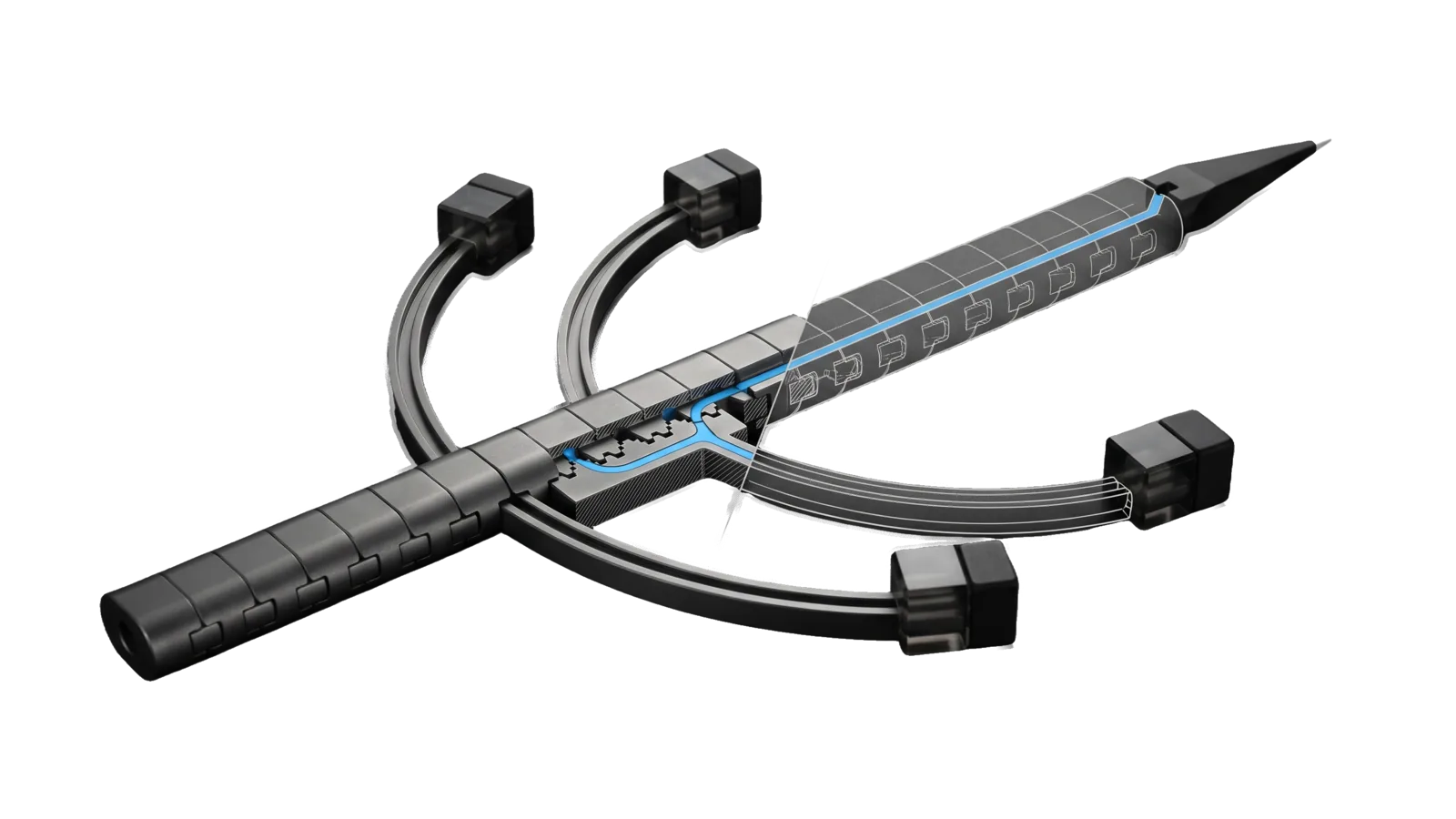
A long segmented spine with curved branch rails carrying shuttle blocks; one shuttle docks into the spine with meshing teeth, and a sky-blue channel runs from it along the ghosted half of the spine to a tapered wedge needle.
Development

ISA

Owns the Ideal State Artifact (ISA): scaffolds, restates, interviews, discusses, rates, renders, upgrades, and maintains the articulation of a project's ideal state

11
Workflows
00
Tools
00
References
37
Triggers

The Problem

When you ask an AI to plan a project or spec out a feature, you usually get a list of tasks, maybe a description of what done looks like. It's vague, not verifiable, and falls apart the moment someone actually tries to build against it. There's no structure for distinguishing what's in scope from what's explicitly out. No way to know if the criteria are testable. No error trail when assumptions break. Every project ends up rediscovering the same missing pieces mid-execution.

How This Skill Approaches It

The ISA (Ideal State Artifact) is a twelve-section document that holds the full articulation of 'done' for any work — code, ops, art, strategy. Scaffold builds one fresh at an effort tier (E1 through E5), with required sections gated by tier so an E1 fix gets Goal and Criteria, and an E5 enterprise project gets all twelve. Interview deepens it through adaptive Q&A. CheckCompleteness scores against the tier gate and blocks progress until gaps are filled. Reconcile handles the parallel-agent case: ephemeral feature slices go out to workers, checkmarks come back deterministically via stable ISC IDs. Seed bootstraps an ISA from an existing repo's code, commits, and README. The result is a single file that serves as ideal state articulation, test harness, done condition, and error-correction trail all at once.

Not for creating new skills (CreateSkill), visual quality critique (ArtDirection), or climbing a target to a measured improvement (HillClimb)

In Action

What you say to your DA, and what the ISA skill actually does.

  • You say "scaffold an isa for this api migration at e3"
    Runs the Scaffold workflow at E3 tier, producing Problem, Vision, Out of Scope, Constraints, Goal, Criteria, Features, and Test Strategy sections with at least one Anti-criteria ISC, then saves it to MEMORY/WORK/{slug}/ISA.md.
  • You say "check if this isa is complete"
    Runs CheckCompleteness, scores each section as present/thin/missing/empty against the declared effort tier gate, and either passes or returns a gap report that blocks phase: complete.
  • You say "seed an isa from the existing repo"
    Runs the Seed workflow, reading the repo's README, commits, and source files to draft a populated ISA, then surfaces it for review before writing to disk.

Inside the Skill

The thinking, frameworks, and architecture that distinguish this skill from a generic version of the same task.

Ideal State

  • Every ISA the skill writes or touches opens with a ladder that passes the shape check, is written from the summit, and agrees with its criteria; anything in the ISA that disagrees with the ladder is resolved before another criterion is climbed.
  • L3 and L2 reach the principal through Restate before a new project or a changed direction is built (an extension whose re-derived L3 or L2 changed counts as one), and not otherwise.
  • An existing ISA is extended in place, never replaced by a second ISA: the new work takes the next F<n> block (or new flat criteria when the ISA is flat) and the next global ISC IDs, no existing ID renumbers, the ladder is re-derived so it covers the new work, and when the re-derived L3 or L2 changed, they reach the principal through Restate before the new work is built.
  • Every criterion is atomic, names its falsifier, and carries at least one ## Test Strategy row in the canonical six-column shape, so Assay resolves the whole table with no dropped row. Each row runs on a lane, liveness for asserts on every monitor tick or integrity for checks that may judge (or build, full runs only), and at a stage, so a criterion's asserts run before its judged rows (ISAFormat § Verifier classes, lanes, and stages; the one progressive contract is skills/Assay/References/Progressive.md).
  • Discuss is the standing alignment loop: whenever the ISA's state says direction is uncertain (bun LIFEOS/TOOLS/IsaAlign.ts status <isa> returns DISCUSS) or the conversation shows doubt about what done means, a Discuss round runs before the uncertain part is built, sized quick, full or deep to the doubt, and Restate, Refine, Rate and the ambiguity check hand off to it when their single-question shapes stop being enough.
  • Every interviewing surface (Discuss, Interview, Questionnaire, Refine, Scaffold's ambiguity check) leaves its raw record in the ISA's append-only ## Articulation Log, and the settled answers reach the ladder and the sections in the same turn.
  • The ISA's history stays auditable: criterion IDs never renumber, and Decisions, Learning and Verification entries keep their canonical shapes.

Intent Routing

Before executing an ISA operation, load its operation bundle:

bun "${CLAUDE_CONFIG_DIR:-$HOME/.claude}/LIFEOS/TOOLS/ContextLoad.ts" ISA load <bundle>

The bundle returns required ISA constraints, operation instructions, and internal references with source hashes. Follow every returned requirement, including conditional reads. Skill-local paths resolve from the skill root; LIFEOS/ paths resolve from the install root. Do not reread unchanged context still present; after compaction or a source change, reload the relevant bundle.

Set the shell and any code-mode wrapper output budget to 30000 tokens. Treat any truncation warning as a failed load, even when END CONTEXTLOAD appears. Use list to discover bundles and search "<query>" to search the complete guide. A failed search does not prove absence: inspect the index, broaden the query, or load full. If routing is uncertain, a bundle is absent, or the loader fails, load or read References/CompleteGuide.md in full before acting.

When the verb is ambiguous, default to Scaffold for a new ISA and CheckCompleteness for an audit.

Intent Trigger File Bundle
Scaffold "scaffold", "create", "generate", "new ISA from this prompt", "extend with a new Feature", "extend in place" Intents/Scaffold.md scaffold
Restate "restate", "say it back", "confirm the direction", "is this what I want", before building a new project or a changed direction Intents/Restate.md restate
CheckCompleteness "check", "audit", "is it complete?" Intents/CheckCompleteness.md check
Discuss "discuss", "discussion", "discovery interview", "figure out the shape", "talk it through", "are we aligned"; IsaAlign.ts status says DISCUSS; a restate answer that is more than a clean yes or a wording fix; asks that cluster; a DISCUSS-FIRST rating; a drift verdict of partial or divergent Intents/Discuss.md discuss
Interview "interview me", "fill in the ISA", "deepen", "ask me questions" Intents/Interview.md interview
Questionnaire "questionnaire", "questions for someone else", "async questions" Intents/Questionnaire.md questionnaire
Refine "refine the ISA", "open questions", "ask me the questions", "take your defaults", mid-run doubt about what done means only the principal can settle, a breakpoint with open asks, close with open asks Intents/Refine.md refine
Rate "rate this ISA", "score this ISA", "ISA quality", "how good is this ISA" Intents/Rate.md rate
Seed "seed", "bootstrap from this repo", "draft an ISA from existing code" Intents/Seed.md seed
Upgrade "upgrade", "check format", "is this ISA current", "latest template", "are all our ISAs updated", "label them as updated" Intents/Upgrade.md upgrade
Append "append decision", "append learning" (C/R/L), "append verification", "record C/R/L entry" Intents/Append.md append
Render (tool-only) "render", "HTML version", "open in browser", "ISA page" bun LIFEOS/TOOLS/ISARender.ts <slug-or-path> [--output <path>] render
Uncertain routing or complete reference anything the rows above do not settle References/CompleteGuide.md full
File Read when
References/CompleteGuide.md the full contract: the twenty-one-section body, the Test Strategy vocabulary and progressive runs, anti-criteria rules, the three-guardrail taxonomy, the substance-scaled completeness gate and who enforces it, the gotchas, the example catalog, and the Algorithm relationship (the full bundle)
References/Discussion.md running any interviewing surface: the ladder shown first, frontier rounds, recommended answers, the challenge question, depth (quick, full, deep with a coverage map), stop conditions, checkpointing to the Articulation Log, folding and the say-back
References/ExtractionPass.md Scaffold runs the Extraction Pass (new-product / new-surface substantial work, or any ask naming a product or URL): source classes, the exemplar comparator contract, total disposition, milestone scope
References/AmbiguityQuestions.md Scaffold's ambiguity check finds material ambiguity, or late information would have changed the ladder: provenance escalation, the one-message template, the proceed match and what it records, re-check later
References/RowClassification.md Scaffold writes a Test Strategy row for a criterion that is not plainly deterministic: the three questions behind eval, pairwise, staged and manual rows
References/GoalLiteralChecks.md CheckCompleteness audits an ISA whose frontmatter carries a principal_stated_goal key: the goal-signal mismatch and artifact-presence checks
Examples/ writing or judging an ISA against a worked one: canonical-isa.md is the one shape template; the e1- through e5- files run from minimal (e1-minimal.md) to the deepest (e5-enterprise.md) and are content references only, since most predate the current shape (CompleteGuide § Examples)

Data & Config

The format authority is ISAFormat and References/CompleteGuide.md; this skill takes no install config. <configRoot>/LIFEOS/USER/CUSTOMIZATIONS/SKILLS/ISA/History.md, when present, holds the install-specific incident detail behind the dated gotchas here and in the intents; it is history, never read as config.

Gotchas

These three bite every intent, so they live here; the rest are in References/CompleteGuide.md § Gotchas.

  • Test Strategy tables must carry the canonical six columns, isc | type | check | threshold | tool | anchors_to. The shipped parser (LIFEOS/TOOLS/lib/IsaTestStrategy.ts, which ISAGate.ts runs) maps cells by the header row and falls back to these canonical positions (anchors_to at cell index 5) for any column the header does not name, so a row whose cells do not line up with its header shifts the anchor into the wrong slot; ISAGate.ts then hard-fails anchors-missing on rows that visibly show an anchor, and the message points at the anchors rather than at the column count. Drop threshold only by writing an empty cell, never by removing the column. (Hit live 2026-07-27 on a large ISA where every flagged row was anchored; incident detail in the USER extension History.md.)
  • The Articulation Log tolerates no embedded headings. Inside a log block, no line may start with #: demote pasted or transcribed headings to bold or blockquote them (> ## Original). CRITERIA_HEADING_RE accepts ### Criteria and parseCapabilities opens on H3 Capabilities, so on a criteria-less ISA (exactly what Discuss creates before Scaffold runs) an unquoted transcript heading becomes the first parser match and everything after it parses as criteria. Only the block's own ### YYYY-MM-DD HH:MM · <source> headers are legal.
  • Browser/HTML view of an ISA goes through bun LIFEOS/TOOLS/ISARender.ts <slug-or-path> [--output <path>], never a hand-rolled renderer or the generic HTML skill. It emits the canonical technical ISA template, deterministic and offline, with per-ISC status pills, the ascent strip, and the Test Strategy table. (2026-08-31: an ISA was hand-rendered twice, first as a distilled report, then as generic markdown-to-HTML, because this tool was referenced nowhere in the skill; the principal's correction encoded here.)

Examples

User: "Scaffold an ISA for the new billing dashboard"
→ Scaffold intent (bundle `scaffold`)
→ A populated ISA at its canonical path, ladder first, every criterion with a Test Strategy row, and L3 and L2 shown through Restate before the build starts
User: "Extend the Lighthouse ISA with a new Feature F7, then restate L3/L2"
→ Scaffold intent (bundle `scaffold`), extending the existing file in place
→ The same ISA with F7 added under the next global ISC IDs, nothing renumbered, the ladder re-derived, and the amended L3 and L2 restated
Restate answer: "sort of, but it is really for teams, not solo users"
→ Discuss intent (bundle `discuss`), align mode, quick depth
→ The ladder shown as it stands, one round of up to four recommended-answer questions including a challenge, the round checkpointed, L1/L2/L3 and the criteria folded, then the corrected L3 and L2 restated
User: "Is this ISA ready to close?"
→ CheckCompleteness intent (bundle `check`)
→ A structured gap report: each gap names its section, severity and reason, and `status: pass` only with zero hard gaps

Workflows & Routing · 11

Each workflow is one job the skill runs. The trigger phrases route your request to the right one — this is the skill's routing table.

  1. 01
    Scaffold Intents/Scaffold.md

    scaffold, create, generate, new ISA from this prompt, extend <existing ISA> with a new Feature, extend in place

  2. 02
    Restate Intents/Restate.md

    restate, say it back, confirm the direction, is this what I want, before building a new project or a changed direction

  3. 03
    CheckCompleteness Intents/CheckCompleteness.md

    check, audit, is it complete?

  4. 04
    `Intents/Interview.md` Workflows/`Intents/Interview.md`.md

    interview me, fill in the ISA, deepen, ask me questions

  5. 05
    `Intents/Questionnaire.md` Workflows/`Intents/Questionnaire.md`.md

    questionnaire, questions for someone else, async questions

  6. 06
    `Intents/Refine.md` Workflows/`Intents/Refine.md`.md

    refine the ISA, open questions, ask me the questions, take your defaults, mid-run doubt about what done means only the principal can settle, a breakpoint with open asks, close with open asks

  7. 07
    `Intents/Rate.md` Workflows/`Intents/Rate.md`.md

    rate this ISA, score this ISA, ISA quality, how good is this ISA

  8. 08
    `Intents/Seed.md` Workflows/`Intents/Seed.md`.md

    seed, bootstrap from this repo, draft an ISA from existing code

  9. 09
    `Intents/Upgrade.md` Workflows/`Intents/Upgrade.md`.md

    upgrade, check format, is this ISA current, latest template, are all our ISAs updated, label them as updated

  10. 10
    `Intents/Append.md` Workflows/`Intents/Append.md`.md

    append decision, append learning (C/R/L), append verification, record C/R/L entry

  11. 11
    `References/CompleteGuide.md` Workflows/`References/CompleteGuide.md`.md

    anything the rows above do not settle

How to Invoke

Say any of these to your DA and LifeOS activates the ISA skill automatically:

  • "ISA"
  • "ISC"
  • "ideal state"
  • "ideal state criteria"
  • "ideal state ladder"
  • "L1 L2 L3"
  • "restate"
  • "say it back"
  • "what do you think I want"
  • "are we building the right thing"
  • "drift check"
  • "project specification"
  • "articulating done"
  • "fog"

Or invoke explicitly:

Skill("ISA")

Want LifeOS to do this for you?

Install LifeOS on your machine — your DA gets the ISA skill plus 96 others, all hooked into one Life OS.