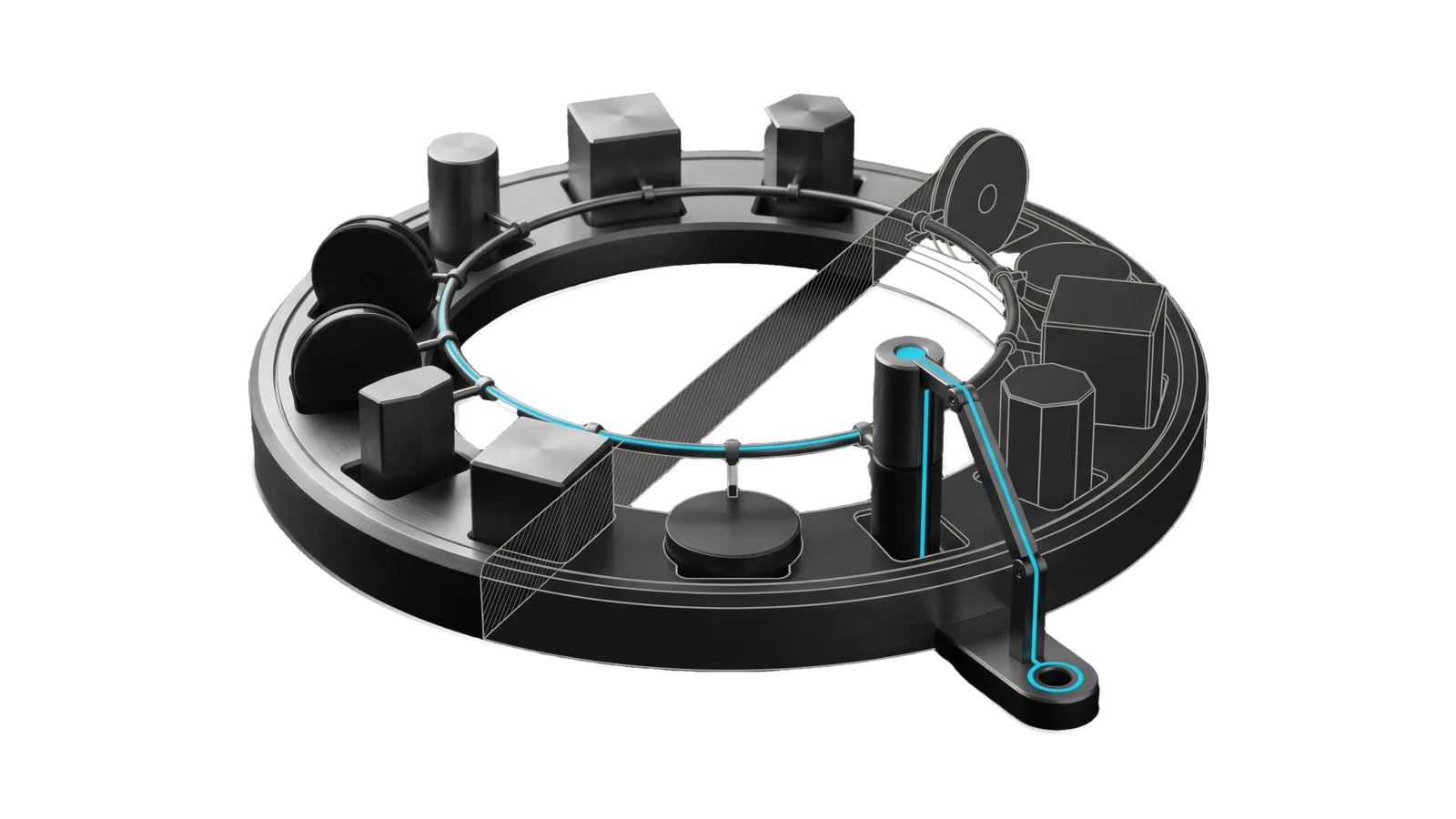
A round graphite turntable holds a ring of sealed cassettes in four shapes joined by a slim rail; a two-jointed arm lifts one cylinder out of its slot, and a cyan line runs from the ring terminal at the arm's base, up the arm, through the lifted cassette and along the rail, with the far half of the ring drawn as a ghosted outline.
Research

Cortex

LifeOS memory, prior-session recall, and learning capture

02
Workflows
01
Tool
00
References
43
Triggers

Key Points

Not for published-content search, or mining one piece of content for the system. argument-hint: [search|add|harvest|develop|ingest|distill|recall|contradictions|graph|retrieve|mine|<query>]

Inside the Skill

The thinking, frameworks, and architecture that distinguish this skill from a generic version of the same task.

Ideal State

  • A recall answer names the prior sessions, ISAs and decisions that match, ranked, each with its date and path, and states what was decided or done there rather than only the topic; when nothing matches, it says so and names the query and the sources searched.
  • An archive search returns a deduplicated table of matching notes (title, domain, status, tags), or an explicit "no matches" with a suggested next step; retrieve returns the top matching notes ranked, with compressed summaries.
  • A captured learning tells the problem, assumption, reality, journey with its dead ends, solution and takeaway, filed under LEARNING/SYSTEM/YYYY-MM/ or LEARNING/ALGORITHM/YYYY-MM/; a recent-history digest lists the files it read and says nothing they do not.
  • All archive operations (add, harvest, develop, ingest) classify each note into one of the six canonical KNOWLEDGE note types and add typed cross-links (related: frontmatter) between notes to keep the graph connected: every new note carries the eight envelope fields and 2-4 typed related: links, each naming a slug that exists in the archive.
  • Every result comes from the command's loaded deterministic tools, and any verification that was unavailable is named in the result as unavailable, never reported as passed.

Anti-criteria

  • Never proceeds on a partial load: a truncated read is not a successful load, and truncation warnings count anywhere in the output, not only at the END CONTEXTLOAD marker.
  • A failed search is never taken to establish absence.
  • No archive write drops the loaded schema, link, or approval requirements.
  • The result never misses a material relevant record, attributes content to the wrong source, or proposes an unauthorized write.
  • No personal configuration is kept inside this public skill.

Intent Routing

Request Bundle Delivers
/knowledge with no arguments status Health dashboard
Archive search, /knowledge <query> or /knowledge search <query> search Notes matching the query
/knowledge add <type> add A new note (People, Companies, Ideas, Research, Books, Blogs)
/knowledge harvest harvest KnowledgeHarvester run over all sources
/knowledge develop develop Seedlings surfaced and enriched
/knowledge ingest <url-or-file> ingest A note from the source, with ripple updates to related notes
/knowledge contradictions contradictions Conflicting claims across notes, reviewed
/knowledge graph [slug] graph Graph stats, or a traversal from /knowledge graph <slug>
/knowledge retrieve <query> retrieve Compressed context retrieval
/knowledge mine mine Memory candidates mined from recent conversations
/knowledge distill distill Weekly routed, cited digest of the archive
/cortex recall <query>, /cs, or "we just worked on", "what did we do with", "remember when we", "didn't we already fix" recall Prior work (sessions, ISAs, conversations, commits) by topic or date phrase, with what was decided and why
Uncertain routing or the whole reference full The complete guide
Intent Trigger File
CaptureLearning "capture this learning", "document this problem", "write up what we learned" Intents/CaptureLearning.md
CheckRecent "what did we learn recently", "check recent history", "recent learnings", "digest the last N learnings" Intents/CheckRecent.md

These two run from their intent files, not a ContextLoad.ts bundle; both work on the LEARNING store (LIFEOS/MEMORY/LEARNING/) and saved research, never the KNOWLEDGE archive.

/cortex <args> and legacy /knowledge <args> route identically. Arguments that do not name a subcommand are archive searches.

File Read when
References/CompleteGuide.md loading full, or reading a command section directly when ContextLoad.ts fails; Context.json maps its headings to the bundles above

Tool contract

Before executing any Cortex command, load its bundle from the Intent Routing table (or full, when the command does not fit a listed bundle or relevance is uncertain) with the deterministic loader: bun "${CLAUDE_CONFIG_DIR:-$HOME/.claude}/LIFEOS/TOOLS/ContextLoad.ts" Cortex load BUNDLE

It returns the selected command instructions and mandatory archive constraints together, with source hashes. Follow every returned requirement. When the loader fails, read References/CompleteGuide.md and the relevant command section directly. Paths in the preserved guide are relative to the skill root. Already-loaded, unchanged sections need no second read; after compaction or a source change, load the relevant bundle again.

For bundle reads, set the shell tool output budget to 30000 tokens. With a code-mode wrapper, also set its output budget to 30000.

Use list to discover sections and bundles, and search "query" to search the preserved guide. When a search finds nothing, inspect the index, broaden the query, or load full.

Data & Config

The distill command reads its optional configuration from LIFEOS/USER/CUSTOMIZATIONS/SKILLS/Cortex/DistillConfig.json, as its loaded instructions describe. Keep personal configuration outside this public skill.

Gotchas

  • None recorded at skill level yet. Command-level gotchas live in References/CompleteGuide.md § Gotchas and load with every bundle.

Examples

Example 1: Recall prior work

User: "recall the invoice for the Texas trip"
→ recall bundle
→ Ranked prior sessions and ISAs with dates and paths, and what each one settled

Example 2: Add a person

User: "add people Jane Doe"
→ add bundle
→ A People note with the eight envelope fields and 2-4 typed related: links to notes that exist

Example 3: Search the archive

User: "what do we know about prompt injection?"
→ Routes to search — 3-pass (lexical + frontmatter + wikilink) over MEMORY/KNOWLEDGE/
→ Returns table of matching notes with domain, status, tags

Example 4: Ingest a source

User: "/knowledge ingest https://example.com/article"
→ Fetches the source, classifies entity type, creates primary note with typed related: links
→ Ripple pass proposes updates to existing related notes; user approves; MOCs regenerated

Example 5: Status check

User: "knowledge status"
→ Runs KnowledgeHarvester.ts status
→ Shows domain note counts, orphan wikilinks, stale seedlings, time since last harvest

Workflows & Routing · 2

Each workflow is one job the skill runs. The trigger phrases route your request to the right one — this is the skill's routing table.

  1. 01
    CaptureLearning Intents/CaptureLearning.md

    capture this learning, document this problem, write up what we learned

  2. 02
    CheckRecent Intents/CheckRecent.md

    what did we learn recently, check recent history, recent learnings, digest the last N learnings

Tools · 1

Deterministic executables the workflows call — the code that does the real work, not prompt scaffolding.

  • ContextSearch.ts

How to Invoke

Say any of these to your DA and LifeOS activates the Cortex skill automatically:

  • "capture this learning"
  • "document this learning"
  • "what did we learn recently"
  • "recent learnings"
  • "cortex"
  • "knowledge"
  • "knowledge base"
  • "search knowledge"
  • "what do we know about"
  • "archive"
  • "harvest"
  • "knowledge status"
  • "develop note"
  • "add to knowledge"

Or invoke explicitly:

Skill("Cortex")

Want LifeOS to do this for you?

Install LifeOS on your machine — your DA gets the Cortex skill plus 96 others, all hooked into one Life OS.