
Overview
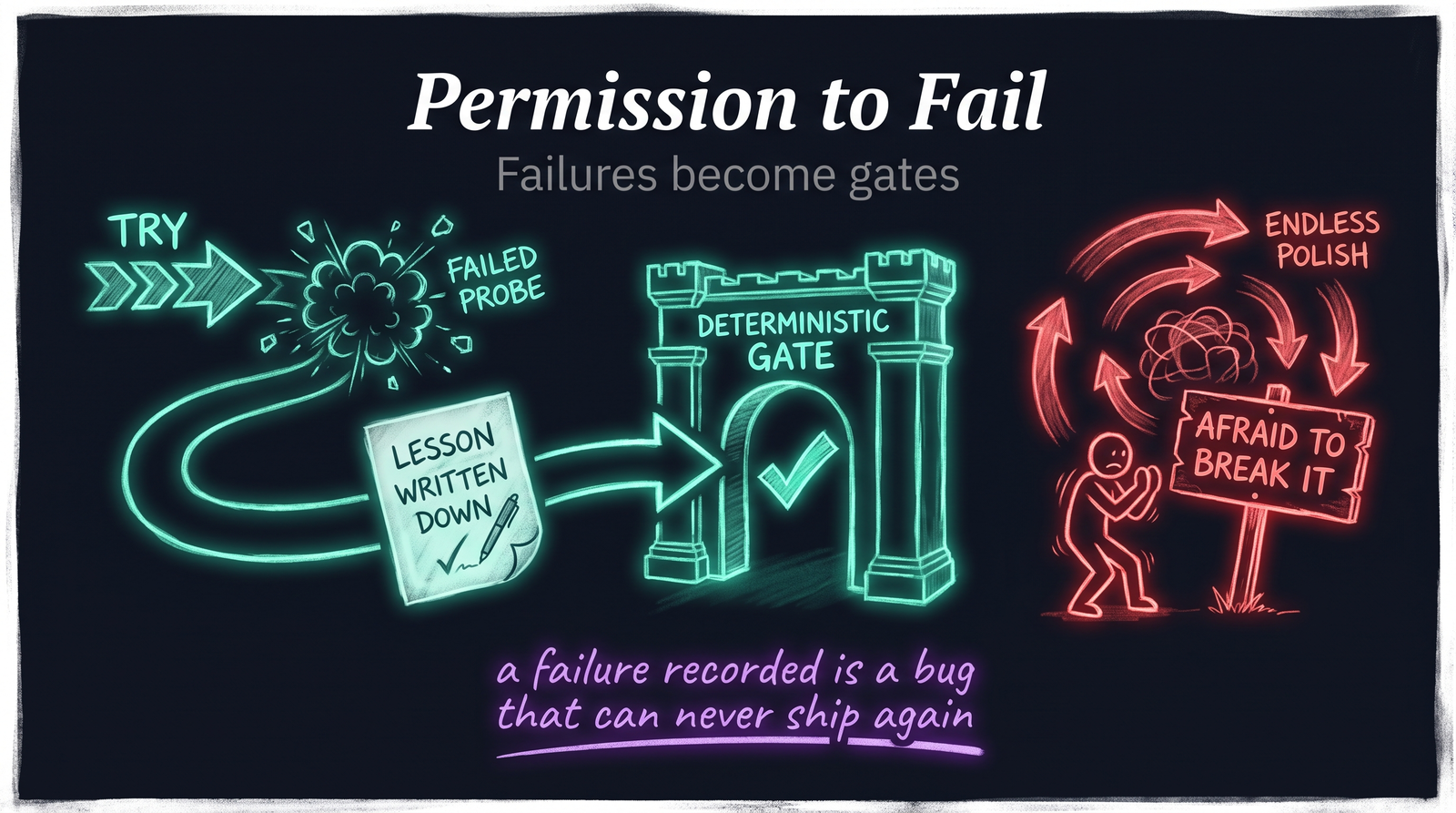
A system that can’t fail safely will avoid trying anything uncertain, and most useful work is uncertain until it’s been tried. Permission to fail means a failed attempt is a normal, expected output of the loop—not an event to be hidden, smoothed over, or avoided by never attempting the risky thing in the first place.
The alternative is worse than the failure itself: a system that polishes its language to sound confident about an untested guess. That produces the appearance of progress with none of the substance, and it’s harder to catch than an honest failure. An honest “that didn’t work, here’s why” is strictly more valuable than a plausible-sounding claim that hasn’t been checked.
The deeper point is that failure is data. A probe that fails tells you something true about the system that a probe that never ran can’t. LifeOS is built to capture that data rather than discard it.
Why This Matters
Without permission to fail:
- The system avoids anything uncertain enough to risk a visible failure
- Failures get hidden behind confident-sounding language instead of reported
- The same mistake recurs because nothing captured why the first attempt failed
- Iteration slows to a crawl because every step has to look successful
With permission to fail:
- Uncertain, high-value attempts get made instead of avoided
- A failure is reported plainly, with what was learned
- Failures convert into deterministic gates so the same mistake can’t recur
- Iteration speeds up because “try it and see” is a legitimate strategy
Implementation
In LifeOS, this manifests through:
Gotchas and incident notes - Failures get written down where they happened (skill References, ISA changelogs, incident docs) instead of disappearing once the immediate problem is patched.
Deterministic gates born from incidents - A hook or scanner added after a real failure (a secret leak, a symlink bypass, a scrub-gate miss) turns a one-time mistake into something the system can never repeat, because a human doesn’t have to remember to check for it again.
The escalation contract - A delegated task that hits a wall returns ESCALATE: <question> instead of grinding to a fake-successful conclusion. Stopping honestly is treated as correct behavior, not as failure to complete the task.
The Upgrades queue - Failed hypotheses about how to improve the system aren’t deleted; they’re recorded so the next proposal doesn’t repeat the same rejected idea.
Examples
Example 1: Reporting a result
- Avoided: skip the risky approach because it might not work, ship something safer but weaker
- Permitted: try the direct approach, and if it fails, report exactly what broke and why
Example 2: A caught mistake
- Hidden: a symlink bypass in a path-boundary check gets quietly patched with no record
- Captured: the incident is logged, a memory-system proposal generalizes the fix, and the class of bug is now checked in three other tools too
Example 3: Claiming done
- Guess dressed as done: “This should work now” (untested)
- Honest failure: “This attempt didn’t fix it—the error is still present after the change, here’s the new evidence”
Related Principles
- Principle #16: Science as Cognitive Loop - A failed test is exactly what a falsifiable hypothesis is supposed to produce sometimes
- Principle #3: Deterministic Where Possible - Converting a failure into a gate is what makes the lesson permanent instead of anecdotal
- Principle #12: History System - Recorded failures are only useful if they persist across sessions instead of being forgotten