
Overview
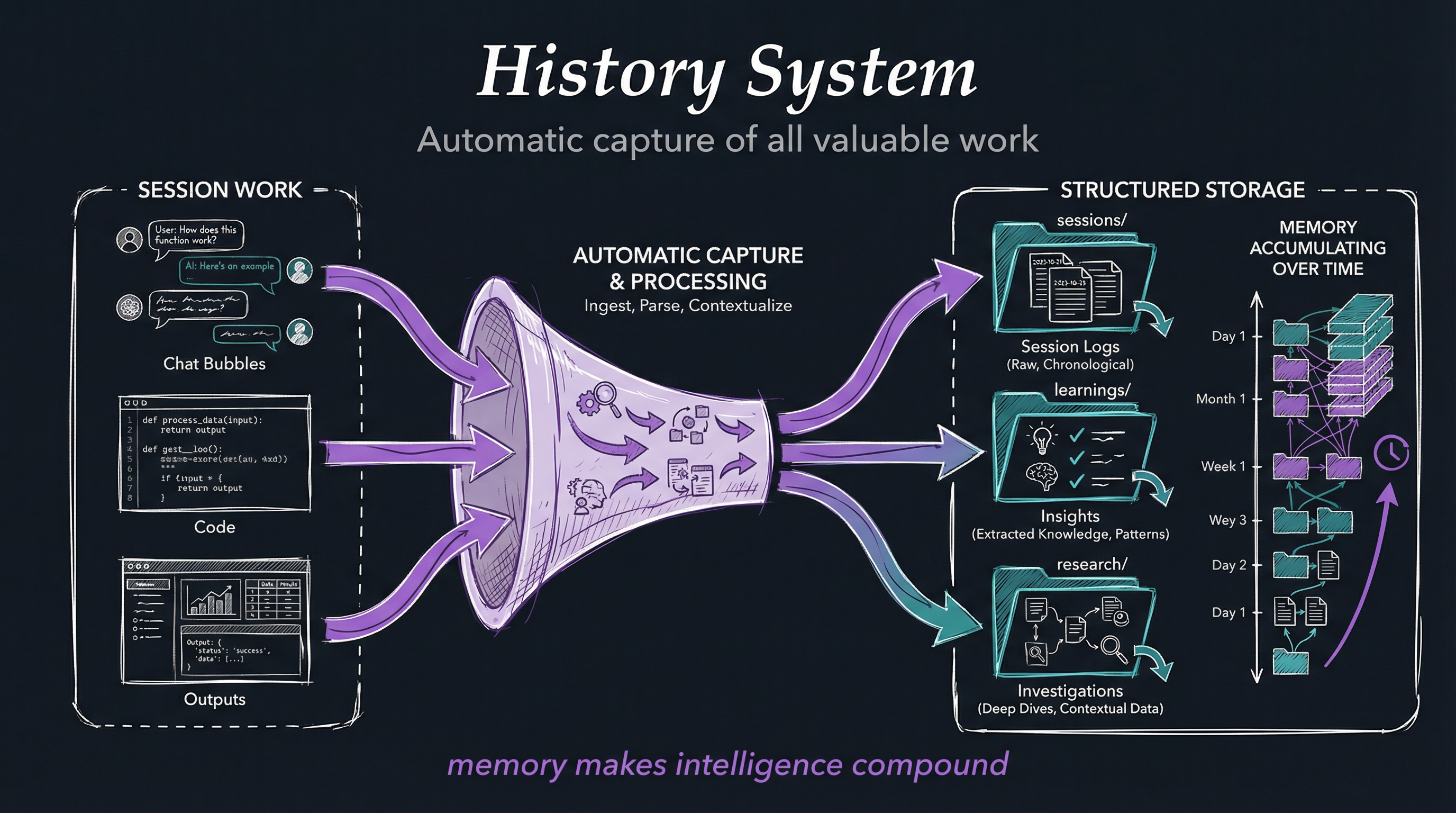
Automatic capture and preservation of valuable work. Memory makes intelligence compound. Without history, every session starts from zero.
Everything gets automatically captured—sessions, learnings, decisions—creating a permanent searchable knowledge base. Not just chat logs. Complete context: what you did, why you did it, what you learned, and what to do next.
The history system is called UOCS (Unified Observation and Context System). It’s the foundation that makes your AI get smarter over time instead of forgetting everything.
Why This Matters
Context creates continuity - When your AI remembers previous work, it doesn’t repeat mistakes or ask questions you’ve already answered.
Patterns emerge from history - Repeated solutions become skills. Common questions become documentation. Frequent workflows become automation.
Knowledge compounds - Month 1: basic usage. Month 6: sophisticated patterns. Month 12: domain expertise. But only if you capture everything.
Delegation becomes possible - You can’t delegate to something with amnesia. “Remember when we…” only works with actual memory.
Debugging requires history - “When did this break?” “What changed?” “Did this used to work?” All impossible without history.
Implementation
LifeOS’s history system is comprehensive, structured, and automatic:
Directory Structure:
History/
├── sessions/          # Complete session captures
├── learnings/         # Extracted insights and patterns
├── research/          # Research artifacts
├── recovery/          # Point-in-time snapshots
├── backups/           # Safe copies before major changes
└── archive/           # Long-term storage
Automatic Capture via Hooks:
Session Hook - Captures every interaction:
- Complete conversation
- Tools used and outputs
- Decisions made
- Context at the time
- Links to related work
Learning Hook - Extracts insights:
- Patterns discovered
- Problems solved
- Mistakes avoided
- Improvements identified
- Future recommendations
Tool Output Hook - Preserves work:
- Code generated
- Research completed
- Content created
- Analyses performed
- Artifacts produced
Search and Retrieval:
- Full-text search across all history
- Date-based filtering
- Category-based organization
- Content MCP for cross-referencing
Examples
Example 1: Project Continuity Without history:
- “What was that solution we used last month?”
- Can’t remember
- Rebuild from scratch
- Waste hours re-solving
With history:
- Search history for project name
- Find session with solution
- Review approach and code
- Apply learned pattern in minutes
Example 2: Learning Accumulation Without history:
- Solve same problem 5 times
- Each time feels new
- No improvement
- Frustrating repetition
With history:
- Solve problem once
- Learning captured automatically
- AI recognizes pattern: “We’ve seen this before”
- Suggests previous solution
- Eventually automated as skill
Example 3: Debugging Without history:
- “This used to work, now it’s broken”
- No idea when it broke
- No idea what changed
- Debug blindly
With history:
- Check recovery snapshots
- Identify when behavior changed
- Review sessions from that period
- Find exact change that broke it
- Fix with confidence
Example 4: Research Builds on Research Without history:
- Research topic
- Forget findings
- Research again later
- Duplicate effort
With history:
- Research captured automatically
- Future research queries history first
- AI: “We already researched this—here’s what we found”
- New research extends previous work
- Knowledge compounds
Related Principles
- Principle #10: Meta / Self-Update System - History enables self-improvement
- Principle #7: ENG / SRE Principles - History provides observability
- Principle #2: Scaffolding > Model - History is scaffolding that outlasts models