
Overview
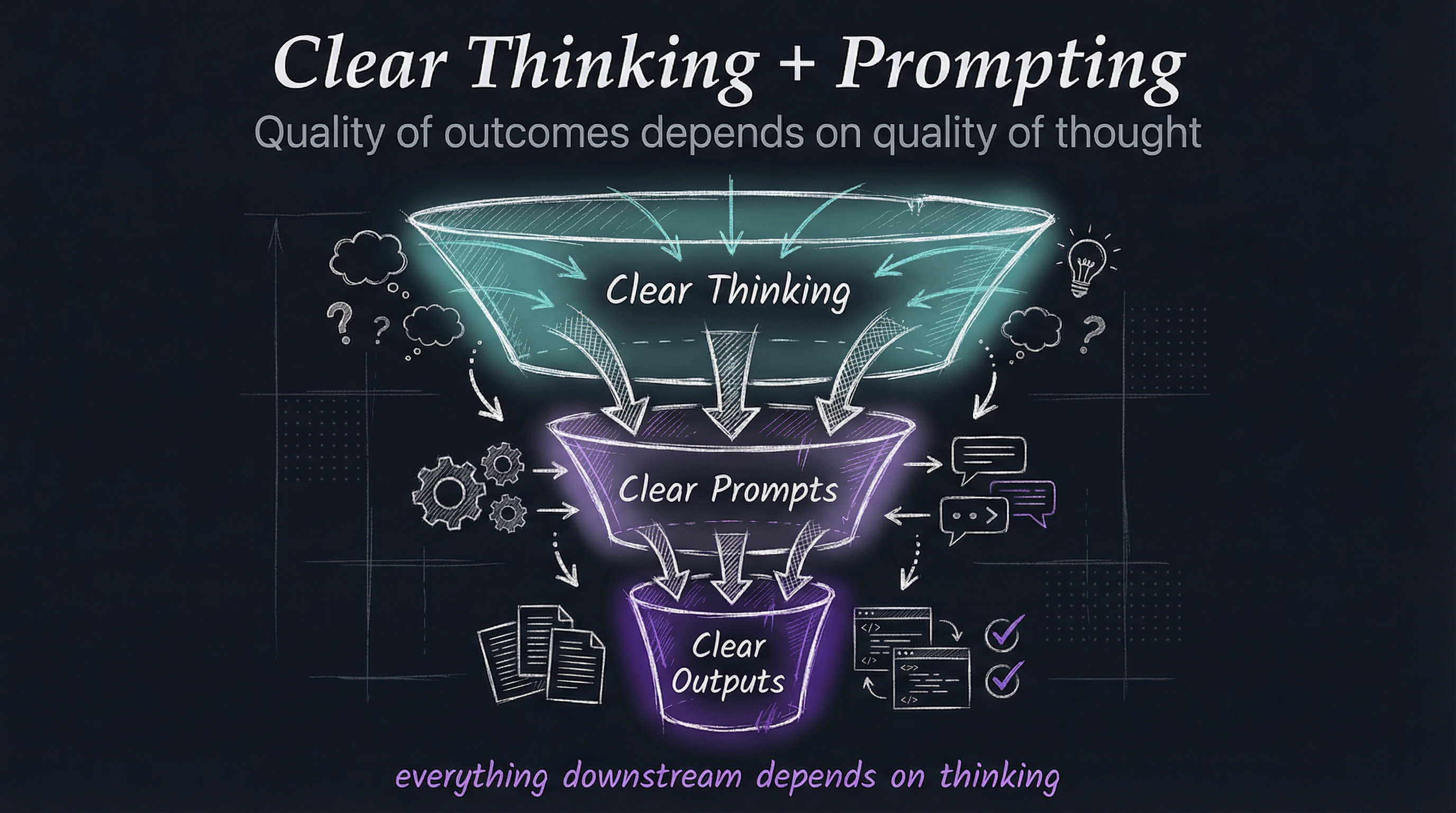
The quality of outcomes depends on the quality of thinking and prompts. Before any code, before any architecture—there must be clear thinking.
Good prompts emerge from clarity about actual needs. “I spend more time clarifying the problem than writing the prompt.” This isn’t a productivity hack—it’s fundamental. When you don’t understand what you’re trying to accomplish, no amount of prompt engineering will save you.
The best AI infrastructure starts with clear thinking about what you’re actually trying to achieve, why it matters, and what success looks like. Everything else follows from that clarity.
Why This Matters
Without clear thinking:
- AI outputs become unpredictable and unreliable
- You can’t write specifications or tests
- Systems drift toward complexity without purpose
- You waste time iterating on unclear objectives
With clear thinking:
- Prompts become precise and effective
- Requirements translate directly into specifications
- Systems remain focused on actual goals
- Iterations improve real outcomes
Implementation
In LifeOS, this manifests through:
Structured Workflows - Skills contain explicit problem statements and solution descriptions before any implementation. You define what you’re solving before writing code.
Specification-First Development - The Spec/Test/Evals principle (Principle #5) requires defining success criteria before building. You can’t specify what you can’t think clearly about.
Prompt Templates - The Prompting skill contains reusable templates that encode clear thinking patterns. These aren’t just text snippets—they’re structured frameworks for thinking.
Agent Personalities - Each specialized agent (Engineer, Researcher, Designer) embodies clear thinking for its domain. The Engineer thinks systematically about architecture. The Researcher thinks critically about sources. The Designer thinks visually about user experience.
Examples
Example 1: Vague vs. Clear
- Vague: “Make the website better”
- Clear: “Reduce homepage load time from 3.2s to under 1.5s by optimizing image delivery and eliminating render-blocking JavaScript”
Example 2: Research Task
- Vague: “Research AI trends”
- Clear: “Identify the top 5 emerging AI infrastructure patterns in Fortune 500 companies during 2024-2025, focusing on internal developer productivity tools, with specific examples and adoption metrics”
Example 3: Code Generation
- Vague: “Create a dashboard”
- Clear: “Build a real-time observability dashboard that displays agent activity via WebSocket, showing event timelines, pulse charts, and swim lanes, with security obfuscation for sensitive data”
Related Principles
- Principle #5: Spec / Test / Evals First - Clear thinking enables precise specifications
- Principle #4: Code Before Prompts - Clarity reveals whether code or prompts solve the problem
- Principle #9: Goal → Code → CLI → Prompts → Agents - Clear goals drive the entire implementation pipeline